Advertisements
Advertisements
Question
What are non-ohmic conductors? Give one exmaple. Draw a current-voltage graph for a non-ohmic conductor.
Advertisements
Solution
The conductors which do not obey Ohm’s law (i.e., V/I is not constant) are called non-ohmic conductors.
Example: Diode valve.

The current-voltage graph for a non-ohmic conductor is shown in figure alongside.
RELATED QUESTIONS
Let the resistance of an electrical component remains constant while the potential difference across the two ends of the component decreases to half of its former value. What change will occur in the current through it?
A low voltage supply from which one needs high currents must have very low internal resistance. Why?
Keeping the p.d. constant, the resistance of a circuit is halved. The current will become:
(a) one-fourth
(b) four time
(c) half
(d) double
What is the necessary condition for a conductor to obey Ohm’s law?
- Draw a V-I graph for a conductor obeying Ohm’s law.
- What does the slope of V–I graph for a conductor represent?
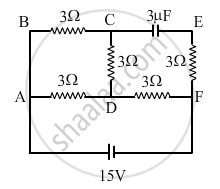
In the circuit shown in the figure, find the total resistance of the circuit and the current in the arm AD.
The ratio of the potential difference to the current is known as ________.
State macroscopic form of Ohm’s law.
Two conductors are made of the same material and have the same length. Conductor A is a solid wire of diameter 1 mm. Conductor B is a hollow tube of outer diameter 2 mm and inner diameter 1 mm. Find the ratio of resistance RA to RB.
