Advertisements
Advertisements
Question
What is an Ohmic resistor?
Advertisements
Solution
Ohmic resistors: The resistors which obey Ohm's law are called ohmic resistors or linear resistances.
Eg: all metallic conductors like silver, aluminium, etc. For such resistors, a graph plotted for the potential difference V against current I is a straight line and the value of resistance R is the same irrespective of the value of V or I.
i.e. V ∝ I
V = IR at constant temperature.
RELATED QUESTIONS
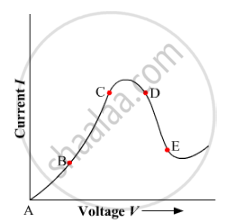
Graph showing the variation of current versus voltage for a material Ga As is shown in the figure. Identify the region of
(i) negative resistance
(ii) where Ohm's law is obeyed.
Is Ohm’s law universally applicable for all conducting elements? If not, give examples of elements which do not obey Ohm’s law.
Write the formula of resistivity
When a 12 V battery is connected across an unknown resistor, there is a current of 2.5 mA in the circuit. Calculate the value of the resistance of the resistor.
- Name and state the law which relates the potential difference and current in a conductor.
- What is the necessary condition for a conductor to obey the law named above in part (a) ?
State and define Ohm’s law.
Explain the equivalent resistance of a series resistor network.
State Ohm’s law? How can it be verified experimentally? Does it hold good under all conditions? Comment.
When two conductors at different electric potentials are joined by a metallic wire, in which direction do the electrons flow?
