Advertisements
Advertisements
Question
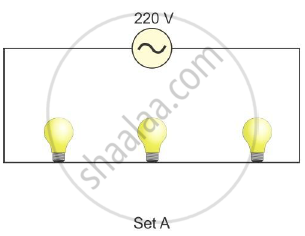
(i) Two sets A and B, of three bulbs each, are glowing in two separate rooms. When one of the bulbs in set A is fused, the other two bulbs also cease to glow. But in set B, when one bulb fuses, the other two bulbs continue to glow. Explain why this phenomenon occurs.
(ii) Why do we prefer arrangements of Set B for house circuiting?
Advertisements
Solution
In set A, all the three bulbs are connected in series. The voltage of source gets divided in all the three bulbs connected in series, and they operate simultaneously. None of the bulb can be operated independently, and hence when one bulb fuses the other two bulbs also cease to glow.
In set B, the three bulbs are connected in parallel. So, even when one of the bulbs ceases to glow, the others continue to glow. Each bulb operates independently.
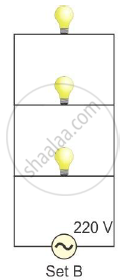
For house circuiting we use the set B arrangement i.e., all the appliances are connected in parallel. The advantage of connecting the appliances in parallel are:
1. Each appliance gets connected to 220 V supply for its normal working.
2. Each appliance works independently without being affected whether the other appliance is switched on or off.
Whereas when connected in series
- All appliances that are connected operate simultaneously and none can be operated independently.
- Voltage of the source gets divided and on connecting one more appliance in the same circuit, the resistance of the circuit will increase. Hence, it will reduce the current in the circuit, so each appliance will get less power.
Hence we prefer arrangements of set B for house circuiting.
APPEARS IN
RELATED QUESTIONS
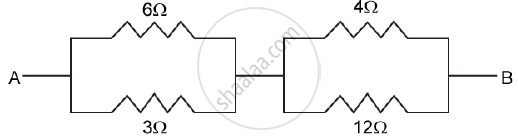
Find the equivalent resistance between A and B
If five resistances, each of value 0.2 ohm, are connected in series, what will be the resultant resistance?
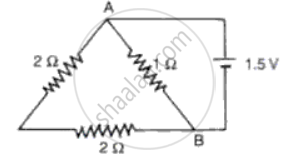
What is the equivalent resistance between A and B in the given circuit (Fig?)
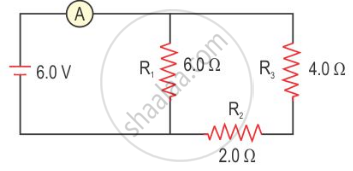
Three resistors of 6.0 Ω, 2.0 Ω and 4.0 Ω are joined to an ammeter A and a cell of emf 6.0 V as shown in the following figure. Calculate :
- the effective resistance of the circuit.
- the reading of ammeter.
When do you say that the resistors are connected in this way? Draw a circuit diagram.
State the effect of rise in temperature on the resistance of semi-conductors.
State expression for Resistance connected in series.
State expression for Resistance connected in parallel.
You are provided with three resistors of resistance 1.0 Ω, 2.0 Ω and 3.0 Ω How would you connect them to obtain the total effective resistance 1.5 Ω? Draw diagram of the arrangement and check it by calculations.
Two resistors having 2Ω and 3Ω resistance are connected—(i) in series, and (ii) in parallel. Find the equivalent resistance in each case.
