Advertisements
Advertisements
Question
Judge the equivalent resistance when the following are connected in parallel − (a) 1 Ω and 106Ω, (b) 1 Ω and 103Ω and 106Ω.
Advertisements
Solution
(a) When 1 Ω and 106 Ω are connected in parallel:
Let R be the equivalent resistance.
R2 = 106 Ω .....[given]
`1/"R" = 1/1 + 1/10^6`
`1/"R" = (10^6 + 1)/10^6`
R = `10^6/(1 + 10^6)` ≈ 1 Ω
R ≈ 1 Ω
Therefore, equivalent resistance ≈ 1 Ω
(b) When 1Ω, 103 Ω and 106 Ω are connected in parallel:
Let R be the equivalent resistance.
`1/"R" = 1/"R"_1 + 1/"R"_2 + 1/"R"_3`
R1 = 1 Ω .....[given]
R2 = 103 Ω
R3 = 106 Ω
`1/"R" = 1/1 + 1/10^3 + 1/10^6`
`1/"R" = (10^6 + 10^3 + 1)/10^6`
`1/"R" = 1001001/1000000`
R = `1000000/1001001` ≈ 0.999 Ω ≈ 1 Ω
R ≈ 1 Ω
APPEARS IN
RELATED QUESTIONS
Complete the following :-
(a)

Two resistors of 4Ω and 6 Ω are connected in parallel to a cell to draw 0.5 A current from the cell.
(i) Draw a labelled circuit diagram showing the above arrangement.
(ii) Calculate the current in each resistor. What is an Ohmic resistor?
(i) Two sets A and B, of three bulbs each, are glowing in two separate rooms. When one of the bulbs in set A is fused, the other two bulbs also cease to glow. But in set B, when one bulb fuses, the other two bulbs continue to glow. Explain why this phenomenon occurs.
(ii) Why do we prefer arrangements of Set B for house circuiting?
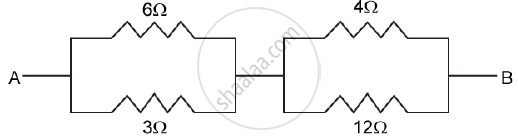
Find the equivalent resistance between A and B
When a 4 Ω resistor is connected across the terminals of a 12 V battery, the number of coulombs passing through the resistor per second is:
(a) 0.3
(b) 3
(c) 4
(d) 12
If the length of a wire is doubled by taking more of wire, what happens to its resistance?
Name the material which is used for making the heating element of an electric iron.
How does the resistance of a pure metal change if its temperature decreases?
State the order of resistivity of (i) a metal, (ii) a semiconductor and (iii) an insulator.
State how are the two resistors joined with a battery when same current flows in each resistor.
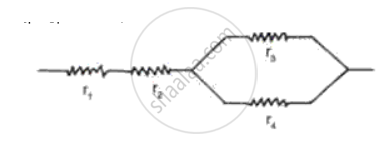
Calculate the equivalent resistance of the following combination of resistor r1, r2, r3, and r4
Bends in a rubber pipe reduce the flow of water through it. How would the bands in a wire affect its electric resistance?
The voltage applied to a given rheostat is made four times its initial value. By what factor will be resistance of the rheostat change?
Four resistances of 2.0Ω each are joined end to end, to form a square ABCD. Calculate the equivalent resistance of the combination between any two adjacent comers.
In the circuit shown below, calculate the equivalent resistance between the points (i) A and B, (ii) C and D.
2Ω resistor A, 1Ω resistor B and 4Ω resistor C are connected in parallel. The combination is connected across a 2V battery of negligible resistance. Draw the diagram of the arrangement and calculate:
(i) The current in each resistor A and C,
(ii) The current through battery.
A metal wire of resistance 6 Ω is stretched so that its length is increased to twice its original length. Calculate its new resistance.
What is the maximum resistance which can be made using five resistors each of `1/5` W?
In an electrical circuit, two resistors of 2 Ω and 4 Ω respectively are connected in series to a 6 V battery. The heat dissipated by the 4 Ω resistor in 5 s will be ______.
