Advertisements
Advertisements
प्रश्न
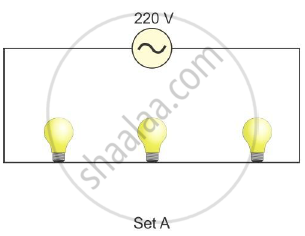
(i) Two sets A and B, of three bulbs each, are glowing in two separate rooms. When one of the bulbs in set A is fused, the other two bulbs also cease to glow. But in set B, when one bulb fuses, the other two bulbs continue to glow. Explain why this phenomenon occurs.
(ii) Why do we prefer arrangements of Set B for house circuiting?
Advertisements
उत्तर
In set A, all the three bulbs are connected in series. The voltage of source gets divided in all the three bulbs connected in series, and they operate simultaneously. None of the bulb can be operated independently, and hence when one bulb fuses the other two bulbs also cease to glow.
In set B, the three bulbs are connected in parallel. So, even when one of the bulbs ceases to glow, the others continue to glow. Each bulb operates independently.
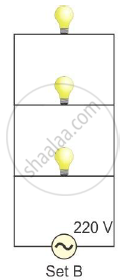
For house circuiting we use the set B arrangement i.e., all the appliances are connected in parallel. The advantage of connecting the appliances in parallel are:
1. Each appliance gets connected to 220 V supply for its normal working.
2. Each appliance works independently without being affected whether the other appliance is switched on or off.
Whereas when connected in series
- All appliances that are connected operate simultaneously and none can be operated independently.
- Voltage of the source gets divided and on connecting one more appliance in the same circuit, the resistance of the circuit will increase. Hence, it will reduce the current in the circuit, so each appliance will get less power.
Hence we prefer arrangements of set B for house circuiting.
APPEARS IN
संबंधित प्रश्न
Find the expression for the resistors connected in series and write the two characteristics of it. (Draw figure).
When a 4 Ω resistor is connected across the terminals of a 12 V battery, the number of coulombs passing through the resistor per second is:
(a) 0.3
(b) 3
(c) 4
(d) 12
Name the material which is the best conductor of electricity.
Calculate the combined resistance in the given case:

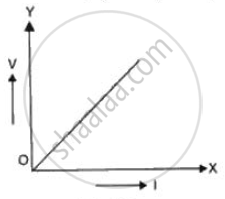
A graph is plotted taking p.d. along y-axis and electric current along x-axis. Name the physical quantity that represents the slope of this graph (Fig.).
Choose the correct alternative and rewrite the following:
You are given three equal resistances. In how many combinations can they are arranged?
State expression for Resistance connected in series.
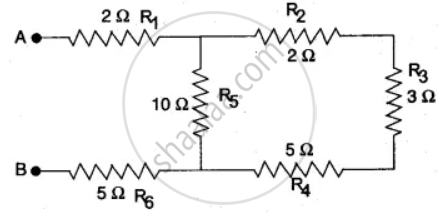
Six resistances are connected together as shown in the figure. Calculate the equivalent resistance between points A and B.
In the circuit shown below, calculate the equivalent resistance between the points (i) A and B, (ii) C and D.
Six equal resistors of 1 ohm each are connected to form the sides of a hexagon ABCDEF. Calculate the resistance offered by the combination if the current enters at A and leaves it at D.
