Advertisements
Advertisements
प्रश्न
Answer the following question.
While studying the dependence of potential difference ( V) across a resistor on the current (I) passing through it, in order to determine the resistance of the resistor, a student took 5 readings for different values of current and plotted a graph between V and t. He got a straight line graph passing through the origin. What does the straight-line signify? Write the method of determining the resistance of the resister using this graph.
Advertisements
उत्तर
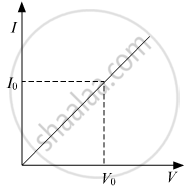
The straight-line graph between the potential difference ( V) and current(I) shows that resistor is a linear element and follows Ohm's Law.
Calculation of Resistance: At any point on the graph, resistance is given as,
`"R" = ("V"_° ("value of potential difference at that point"))/("I"_° ("value of current at that point"))`
In other words, the Slope of the graph at any point gives the value `1/"R"`
Hence,
slope `="I"_°/"V"_° = 1/"R"`
`⇒ "R" = 1/"slope" =( "V"_° ("Value of Potential difference at that point"))/("I"_° ("Value of current at that point"))`
APPEARS IN
संबंधित प्रश्न
Judge the equivalent resistance when the following are connected in parallel − (a) 1 Ω and 106Ω, (b) 1 Ω and 103Ω and 106Ω.
If the length of a wire is doubled by taking more of wire, what happens to its resistance?
Name the material which is used for making the heating element of an electric iron.
Write down an expression for the resistance of a metallic wire in terms of the resistivity.
Give the law of combination of resistances in series.
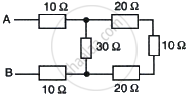
What is the resistance between A and B in the figure given below?
State how are the two resistors joined with a battery when equivalent resistance is more than either of the two resistances.
How will you oonnect five resistors, each of the value one ohm, to obtain an equivalent resistance of 0.2 `Omega`
What material is used for making wire to prepare heating coils? Give a reason.
Calculate the value of the resistance which must be connected to a 15 ohm resistance to provide on effective resistance of 6 ohm.
