Advertisements
Advertisements
प्रश्न
Answer the following question.
While studying the dependence of potential difference ( V) across a resistor on the current (I) passing through it, in order to determine the resistance of the resistor, a student took 5 readings for different values of current and plotted a graph between V and t. He got a straight line graph passing through the origin. What does the straight-line signify? Write the method of determining the resistance of the resister using this graph.
Advertisements
उत्तर
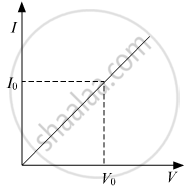
The straight-line graph between the potential difference ( V) and current(I) shows that resistor is a linear element and follows Ohm's Law.
Calculation of Resistance: At any point on the graph, resistance is given as,
`"R" = ("V"_° ("value of potential difference at that point"))/("I"_° ("value of current at that point"))`
In other words, the Slope of the graph at any point gives the value `1/"R"`
Hence,
slope `="I"_°/"V"_° = 1/"R"`
`⇒ "R" = 1/"slope" =( "V"_° ("Value of Potential difference at that point"))/("I"_° ("Value of current at that point"))`
APPEARS IN
संबंधित प्रश्न
A battery of 9 V is connected in series with resistors of 0.2 Ω, 0.3 Ω, 0.4 Ω, 0.5 Ω and 12 Ω, respectively. How much current would flow through the 12 Ω resistor?
Two resistors of 4Ω and 6 Ω are connected in parallel to a cell to draw 0.5 A current from the cell.
(i) Draw a labelled circuit diagram showing the above arrangement.
(ii) Calculate the current in each resistor. What is an Ohmic resistor?
If the length of a wire is doubled by taking more of wire, what happens to its resistance?
Name the material which is the best conductor of electricity.
How does the presence of impurities in a metal affect its resistance?
Two resistances X and Y are connected turn by turn:
- in parallel, and
- in series.
In which case the resultant resistance will be less than either of the individual resistances?
In series combination of resistances ______.
What material is used for making wire to prepare heating coils? Give a reason.
Two resistors of 4Ω and 6Ω are connected in parallel to a cell to draw 0.5 A current from the cell. Calculate the current in each resistor.
