Advertisements
Advertisements
प्रश्न
Two resistors of 4Ω and 6Ω are connected in parallel to a cell to draw 0.5 A current from the cell. Calculate the current in each resistor.
Advertisements
उत्तर
`1/"R" = 1/4 + 1/6`
R = 2.4 Ω
⇒ V = IR
V = 0.5 × 2.4 = 1.2 V
i1 = `"V"/"R"_1`
`= 1.2/4 = 0.3 "A"`
i2 = `1.2/6 = 0.2` A
संबंधित प्रश्न
Find the expression for the resistors connected in series and write the two characteristics of it. (Draw figure).
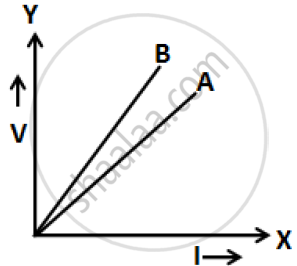
The V-I graph for a series combination and for a parallel combination of two resistors is shown in the figure below. Which of the two A or B. represents the parallel combination? Give reasons for your answer.
What possible values of resultant resistance one can get by combining two resistances, one of value 2 ohm and the other 6 ohm?
What is (a) highest, and (b)Ω lowest, resistance which can be obtained by combining four resistors having the following resistances?
4 Ω, 8 Ω, 12 Ω, 24 Ω
Choose the correct alternative and rewrite the following sentence.
If three resistors 2 ohms, 3 ohms and 4 ohms are connected in series, then the effective resistance in the circuit will be _______ ohms.
State expression for Resistance connected in series.
You are provided with three resistors of resistance 1.0 Ω, 2.0 Ω and 3.0 Ω How would you connect them to obtain the total effective resistance 1.5 Ω? Draw diagram of the arrangement and check it by calculations.
If R1 and R2 be the resistance of the filament of 40 W and 60 W respectively operating 220 V, then:
Two electric bulbs have resistances in the ratio 1 : 2. If they are joined in series, the energy consumed in them is in the ratio:
Show how you would connect three resistors, each of resistance 6 Ω, so that the combination has a resistance of 4 Ω.
