Advertisements
Advertisements
प्रश्न
Calculate the resistance of an aluminium cable of length 10 km and diameter 2.0 mm if the resistivity of aluminium is 27 × 10−8 Ωm.
Advertisements
उत्तर
Length of the cable wire, l = 10 km = 10000 m
Diameter of the cable wire, d = 2.0 mm
Radius of the cable wire, r = 1.0 mm = 1.0 × 10⁻³ m
Area of cross-section, A = πr2
= π(1.0 × 10⁻³)2
= π × 1.0 × 10⁻⁶
Resistivity of the aluminium cable wire = 27 × 10−8 Ω m.
Let the resistance of the aluminium cable be R.
We know that `R = (rho l)/A`
`R = (27 xx 10^-8 xx 10^3 xx 10)/(pi xx 10^-6)`
`R = (27 xx 10^-8 xx 10^4)/(3.14xx10^-6)`
`R = (27 xx 10^2)/pi`
R = 86 Ω
APPEARS IN
संबंधित प्रश्न
Find the expression for the resistors connected in series and write the two characteristics of it. (Draw figure).
Judge the equivalent resistance when the following are connected in parallel − (a) 1 Ω and 106Ω, (b) 1 Ω and 103Ω and 106Ω.
A piece of wire of resistance R is cut into five equal parts. These parts are then connected in parallel. If the equivalent resistance of this combination is R’, then the ratio `"R"/"R'"` is ______.
A battery of 9 V is connected in series with resistors of 0.2 Ω, 0.3 Ω, 0.4 Ω, 0.5 Ω and 12 Ω, respectively. How much current would flow through the 12 Ω resistor?
(i) Two sets A and B, of three bulbs each, are glowing in two separate rooms. When one of the bulbs in set A is fused, the other two bulbs also cease to glow. But in set B, when one bulb fuses, the other two bulbs continue to glow. Explain why this phenomenon occurs.
(ii) Why do we prefer arrangements of Set B for house circuiting?
Name the material which is used for making the heating element of an electric iron.
Give one example to show how the resistance depends on the nature of material of the conductor.
How does the resistance of a wire change when:
its diameter is tripled?
When do you say that the resistors are connected in this way? Draw a circuit diagram.
Answer the following question.
While studying the dependence of potential difference ( V) across a resistor on the current (I) passing through it, in order to determine the resistance of the resistor, a student took 5 readings for different values of current and plotted a graph between V and t. He got a straight line graph passing through the origin. What does the straight-line signify? Write the method of determining the resistance of the resister using this graph.
Why are thick copper wires used as connecting wires?
Write an expression for the resistance of a conducting wire in terms of its length and area of cross-section.
What is a resistance? Define it with respect to Ohm’s law,
State and explain the laws of resistance.
Six resistances are connected together as shown in the figure. Calculate the equivalent resistance between points A and B.
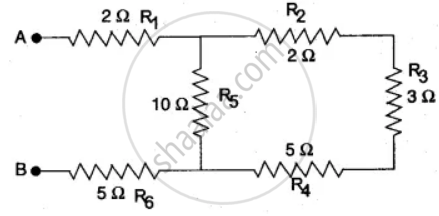
Two resistors of 4Ω and 6Ω are connected in parallel to a cell to draw 0.5 A current from the cell. Calculate the current in each resistor.
Two resistors having 2Ω and 3Ω resistance are connected—(i) in series, and (ii) in parallel. Find the equivalent resistance in each case.
The resistance of two resistors joined in series is 8Ω and in parallel is 1.5Ω. Find the value of the two resistances.
When a 4 Ω resistor is connected across the terminals of a 2 V battery, the number of coulombs passing through the resistor per second is:
