Advertisements
Advertisements
प्रश्न
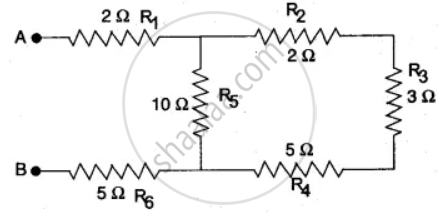
Six resistances are connected together as shown in the figure. Calculate the equivalent resistance between points A and B.
Advertisements
उत्तर
The resistors R2, R3 and R4 in series.
∴ R' = R2 + R3 + R4
= 2 + 3 + 5 = 10 Ω
Now R' and R5 are in parallel.
∴ `1/("R"'') = 1/("R"') + 1/"R"_5`
`= 1/10 + 1/10 = 2/10 = 1/5`
∴ R'' = 5 Ω
Now R1, R” and R6 in series between the points A and B. The equivalent resistance between A and B is
R = R1 + R” + R6 = 2 + 5 + 5 = 12 Ω
APPEARS IN
संबंधित प्रश्न
In series combination which remains constant?
(a) Voltage
(b) Current
(c) Both current and voltage
(d) Both are variables
Judge the equivalent resistance when the following are connected in parallel − (a) 1 Ω and 106Ω, (b) 1 Ω and 103Ω and 106Ω.
(i) Two sets A and B, of three bulbs each, are glowing in two separate rooms. When one of the bulbs in set A is fused, the other two bulbs also cease to glow. But in set B, when one bulb fuses, the other two bulbs continue to glow. Explain why this phenomenon occurs.
(ii) Why do we prefer arrangements of Set B for house circuiting?
The substance having infinitely high electrical resistance is called:
(a) conductor
(b) resistor
(c) superconductor
(d) insulator
What possible values of resultant resistance one can get by combining two resistances, one of value 2 ohm and the other 6 ohm?
What potential difference is needed to drive a current o f 1 A through a 5 Ω resistor?
How will you oonnect five resistors, each of the value one ohm, to obtain an equivalent resistance of 0.2 `Omega`
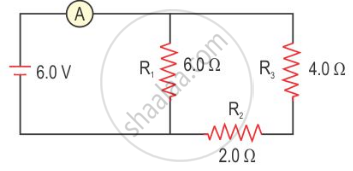
Three resistors of 6.0 Ω, 2.0 Ω and 4.0 Ω are joined to an ammeter A and a cell of emf 6.0 V as shown in the following figure. Calculate :
- the effective resistance of the circuit.
- the reading of ammeter.
Answer the following question.
While studying the dependence of potential difference ( V) across a resistor on the current (I) passing through it, in order to determine the resistance of the resistor, a student took 5 readings for different values of current and plotted a graph between V and t. He got a straight line graph passing through the origin. What does the straight-line signify? Write the method of determining the resistance of the resister using this graph.
