Advertisements
Advertisements
प्रश्न
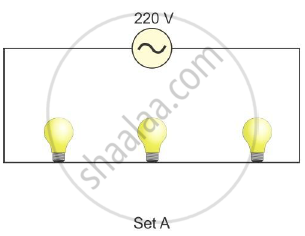
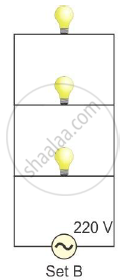
(i) Two sets A and B, of three bulbs each, are glowing in two separate rooms. When one of the bulbs in set A is fused, the other two bulbs also cease to glow. But in set B, when one bulb fuses, the other two bulbs continue to glow. Explain why this phenomenon occurs.
(ii) Why do we prefer arrangements of Set B for house circuiting?
Advertisements
उत्तर
In set A, all the three bulbs are connected in series. The voltage of source gets divided in all the three bulbs connected in series, and they operate simultaneously. None of the bulb can be operated independently, and hence when one bulb fuses the other two bulbs also cease to glow.
In set B, the three bulbs are connected in parallel. So, even when one of the bulbs ceases to glow, the others continue to glow. Each bulb operates independently.
For house circuiting we use the set B arrangement i.e., all the appliances are connected in parallel. The advantage of connecting the appliances in parallel are:
1. Each appliance gets connected to 220 V supply for its normal working.
2. Each appliance works independently without being affected whether the other appliance is switched on or off.
Whereas when connected in series
- All appliances that are connected operate simultaneously and none can be operated independently.
- Voltage of the source gets divided and on connecting one more appliance in the same circuit, the resistance of the circuit will increase. Hence, it will reduce the current in the circuit, so each appliance will get less power.
Hence we prefer arrangements of set B for house circuiting.
संबंधित प्रश्न
If the equivalent resistance is to be increased, then the number of resistances should be connected in
- Series
- Parallel
- Mixed arrangement
- None of the above
Write any two characteristics of a series combination of resistors.
An electrical appliance has a resistance of 25 Ω. When this electrical appliance is connected to a 230 V supply line, the current passing through it will be:
(a) 0.92 A
(b) 2.9 A
(c) 9.2 A
(d) 92 A
Write down an expression for the resistance of a metallic wire in terms of the resistivity.
How does the resistance of a wire change when:
its length is tripled?
Choose the correct alternative and rewrite the following sentence.
If three resistors 2 ohms, 3 ohms and 4 ohms are connected in series, then the effective resistance in the circuit will be _______ ohms.
Four resistances of 2.0Ω each are joined end to end, to form a square ABCD. Calculate the equivalent resistance of the combination between any two adjacent comers.
2Ω resistor A, 1Ω resistor B and 4Ω resistor C are connected in parallel. The combination is connected across a 2V battery of negligible resistance. Draw the diagram of the arrangement and calculate:
(i) The current in each resistor A and C,
(ii) The current through battery.
Illustrate-combination of cells e.g., three cells, in series, explaining the combination briefly. Obtain an expression for current ‘i’ in the combination.
Two resistors of 4Ω and 6Ω are connected in parallel to a cell to draw 0.5 A current from the cell.
Draw a labelled circuit diagram showing the above arrangement.
