Advertisements
Advertisements
प्रश्न
Find the expression for resistors connected in series.
Advertisements
उत्तर
When two or more resistors are joined from end to end, the resistances are connected in series.
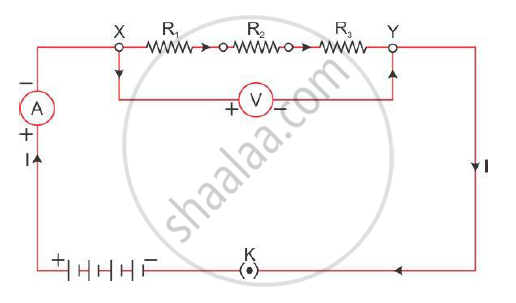
The current in series remains the same across all the resistors.
The potential difference is the sum of potential differences across all the individual resistors.
V = V1 + V2 + V3 … (1)
Let I be the current in the circuit.
On applying Ohm’s law to the entire circuit, we get
V = IRs … (2)
Here, Rs is the combined resistance of the circuit.
Now, applying Ohm’s law to individual resistances, we get
V1 = IR1
V2 = IR2
V3 = IR3 ......(3)
From equations (1), (2) and (3), we get
IRs = IR1 + IR2 + IR3
∴ Rs = R1 + R2 + R3
Here, Rs is the resultant resistance. Thus, the resultant resistance of a series combination of resistors is the sum of individual resistances.
The resultant resistance is greater than all the resistances.
APPEARS IN
संबंधित प्रश्न
Find the expression for the resistors connected in series and write the two characteristics of it. (Draw figure).
If the equivalent resistance is to be increased, then the number of resistances should be connected in
- Series
- Parallel
- Mixed arrangement
- None of the above
A battery of 9 V is connected in series with resistors of 0.2 Ω, 0.3 Ω, 0.4 Ω, 0.5 Ω and 12 Ω, respectively. How much current would flow through the 12 Ω resistor?
How does the presence of impurities in a metal affect its resistance?
Calculate the resistance of an aluminium cable of length 10 km and diameter 2.0 mm if the resistivity of aluminium is 27 × 10−8 Ωm.
How does the resistance of a wire change when:
its diameter is tripled?
State how are the two resistors joined with a battery when equivalent resistance is more than either of the two resistances.
State how are the two resistors joined with a battery when same current flows in each resistor.
What potential difference is needed to drive a current o f 1 A through a 5 Ω resistor?
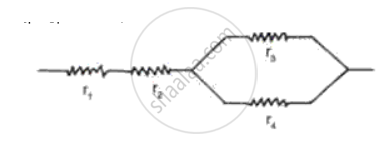
Calculate the equivalent resistance of the following combination of resistor r1, r2, r3, and r4
Choose the correct alternative and rewrite the following:
You are given three equal resistances. In how many combinations can they are arranged?
2Ω resistor A, 1Ω resistor B and 4Ω resistor C are connected in parallel. The combination is connected across a 2V battery of negligible resistance. Draw the diagram of the arrangement and calculate:
(i) The current in each resistor A and C,
(ii) The current through battery.
Two resistors of 4Ω and 6Ω are connected in parallel to a cell to draw 0.5 A current from the cell. Calculate the current in each resistor.
What should be the length of a nickel wire of area of cross-section 3 mm2 used for making a rheostat of 750 ohm? (ρ of nickle = 0.069 Ohm mm2/m)
Two resistors having 2Ω and 3Ω resistance are connected—(i) in series, and (ii) in parallel. Find the equivalent resistance in each case.
With the help of a circuit diagram derive the formula for the resultant resistance of three resistances connected:
- in series and
- in parallel
If the current I through a resistor is increased by 100% (assume that temperature remains unchanged), the increase in power dissipated will be:
