Advertisements
Advertisements
प्रश्न
Find the expression for resistors connected in series.
Advertisements
उत्तर
When two or more resistors are joined from end to end, the resistances are connected in series.
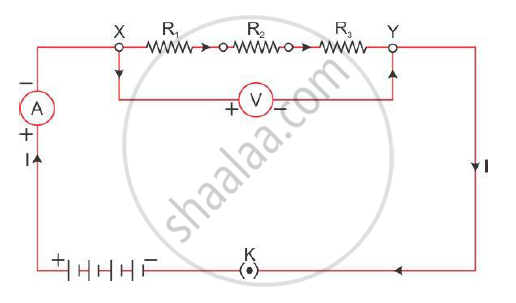
The current in series remains the same across all the resistors.
The potential difference is the sum of potential differences across all the individual resistors.
V = V1 + V2 + V3 … (1)
Let I be the current in the circuit.
On applying Ohm’s law to the entire circuit, we get
V = IRs … (2)
Here, Rs is the combined resistance of the circuit.
Now, applying Ohm’s law to individual resistances, we get
V1 = IR1
V2 = IR2
V3 = IR3 ......(3)
From equations (1), (2) and (3), we get
IRs = IR1 + IR2 + IR3
∴ Rs = R1 + R2 + R3
Here, Rs is the resultant resistance. Thus, the resultant resistance of a series combination of resistors is the sum of individual resistances.
The resultant resistance is greater than all the resistances.
APPEARS IN
संबंधित प्रश्न
In series combination which remains constant?
(a) Voltage
(b) Current
(c) Both current and voltage
(d) Both are variables
Find the expression for the resistors connected in series and write the two characteristics of it. (Draw figure).
Complete the following :-
(a)

A piece of wire of resistance R is cut into five equal parts. These parts are then connected in parallel. If the equivalent resistance of this combination is R’, then the ratio `"R"/"R'"` is ______.
A battery of 9 V is connected in series with resistors of 0.2 Ω, 0.3 Ω, 0.4 Ω, 0.5 Ω and 12 Ω, respectively. How much current would flow through the 12 Ω resistor?
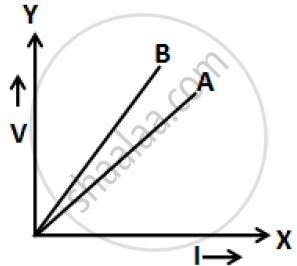
The V-I graph for a series combination and for a parallel combination of two resistors is shown in the figure below. Which of the two A or B. represents the parallel combination? Give reasons for your answer.
If the length of a wire is doubled by taking more of wire, what happens to its resistance?
If five resistances, each of value 0.2 ohm, are connected in series, what will be the resultant resistance?
A p.d. of 4 V is applied to two resistors of 6 Ω and 2 Ω connected in series. Calculate:
(a) the combined resistance
(b) the current flowing
(c) the p.d. across the 6 Ω resistor
State how are the two resistors joined with a battery when equivalent resistance is more than either of the two resistances.
In series combination of resistances ______.
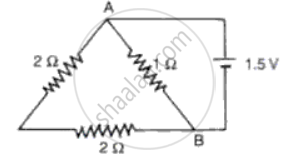
What is the equivalent resistance between A and B in the given circuit (Fig?)
A given metallic wire of resistance R is doubled on itself. What will be its new resistance?
Define the term resistivity and state its S.I. unit. Which will have higher resistivity a conductor or an insulator.
2Ω resistor A, 1Ω resistor B and 4Ω resistor C are connected in parallel. The combination is connected across a 2V battery of negligible resistance. Draw the diagram of the arrangement and calculate:
(i) The current in each resistor A and C,
(ii) The current through battery.
Illustrate-combination of cells e.g., three cells, in series, explaining the combination briefly. Obtain an expression for current ‘i’ in the combination.
What should be the length of a nickel wire of area of cross-section 3 mm2 used for making a rheostat of 750 ohm? (ρ of nickle = 0.069 Ohm mm2/m)
