Advertisements
Advertisements
प्रश्न
What do you mean by power rating of an electrical appliance? How do you use it to calculate
(a) the resistance of the appliance and
(b) the safe limit of the current in it, while in use?
Advertisements
उत्तर
An electrical appliance such as electric bulb, geyser etc. is rated with power (P) and voltage (V) which is known as its power rating. For example: If an electric bulb is rated as 50W-220V, it means that when the bulb is lighted on a 220 V supply, it consumes 50 W electrical power.
(a) To calculate the resistance of the appliance, the expression is:
Resisteance , R = `"V"^2/"P"`
(b) The safe limit of current I is : I = `"P"/"V"`
संबंधित प्रश्न
A battery of 9 V is connected in series with resistors of 0.2 Ω, 0.3 Ω, 0.4 Ω, 0.5 Ω and 12 Ω, respectively. How much current would flow through the 12 Ω resistor?
Why is the series arrangement not used for domestic circuits?
Give the law of combination of resistances in series.
State the order of resistivity of (i) a metal, (ii) a semiconductor and (iii) an insulator.
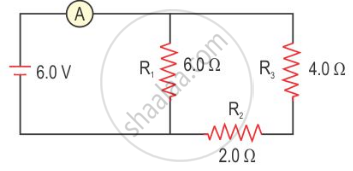
Three resistors of 6.0 Ω, 2.0 Ω and 4.0 Ω are joined to an ammeter A and a cell of emf 6.0 V as shown in the following figure. Calculate :
- the effective resistance of the circuit.
- the reading of ammeter.
Define the term resistivity and state its S.I. unit. Which will have higher resistivity a conductor or an insulator.
You are provided with three resistors of resistance 1.0 Ω, 2.0 Ω and 3.0 Ω How would you connect them to obtain the total effective resistance 1.5 Ω? Draw diagram of the arrangement and check it by calculations.
Calculate the value of the resistance which must be connected to a 15 ohm resistance to provide on effective resistance of 6 ohm.
Calculate the quantity of heat that will be produced in a coil of resistance 75 Ω if a current of 2A is passed through it for 2 minutes.
