Advertisements
Advertisements
प्रश्न
State and explain the laws of resistance.
Advertisements
उत्तर
The following are the main laws of resistance:
(i) Resistance of a conductor is directly proportional to its length, provided temperature and other physical conditions remain unchanged.
It means that R ∝ l i.e., if the length increases, the resistance also increases and if length decreases, its resistance also decreases.
(ii) Resistance of a conductor is inversely proportional to its area of cross section, other conditions remaining the same.
If A is the area of cross section, then:
R α `1/"A"`
or R α `1/(pi"r"^2)`
where r is the radius of the wire
Keeping the length same, if the radius of the wire is doubled then:
R α `1/(2"r")^2` α `1/"4r"^2`
or R α `1/4 . 1/(pi"r"^2)`, or R becomes one fourth.
Similarly if r is made half, then:
R α `1/("r"/2)^2`
α `4/"r"^2 α 4 (1/"r"^2)`, orR becomes 4 times
This shows that R is α `1/"A"`
(iii) R depends on the nature of the material of the conductor. It means, if we take equal lengths of wires of copper, aluminium and iron and all of the same cross-sectional area, their resistance are different from each other since they are of different materials.
संबंधित प्रश्न
In series combination which remains constant?
(a) Voltage
(b) Current
(c) Both current and voltage
(d) Both are variables
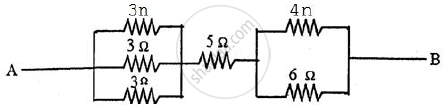
Find the equivalent resistance between points A and B
Name the material which is the best conductor of electricity.
How does the resistance of a wire change when:
its length is tripled?
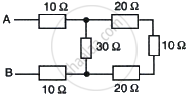
What is the resistance between A and B in the figure given below?
When do you say that the resistors are connected in this way? Draw a circuit diagram.
Name the material of wire used for making standard resistances. Give a reason.
State expression for Resistance connected in parallel.
If R1 and R2 be the resistance of the filament of 40 W and 60 W respectively operating 220 V, then:
