Advertisements
Advertisements
प्रश्न
Choose the correct alternative and rewrite the following:
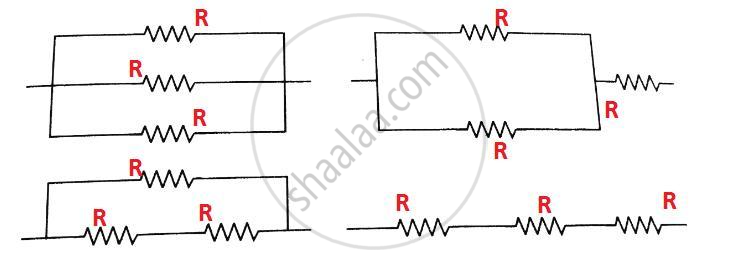
You are given three equal resistances. In how many combinations can they are arranged?
पर्याय
Three
Four
Five
Two
Advertisements
उत्तर
Four
Three equal resistances can be connected in four different combinations:
- All three are in parallel.
- Two in parallel and third in series.
- Two in series and third in parallel of both.
- All three are in series.
APPEARS IN
संबंधित प्रश्न
Find the expression for the resistors connected in series and write the two characteristics of it. (Draw figure).
Two resistors of 4Ω and 6 Ω are connected in parallel to a cell to draw 0.5 A current from the cell.
(i) Draw a labelled circuit diagram showing the above arrangement.
(ii) Calculate the current in each resistor. What is an Ohmic resistor?
Name the material which is used for making the heating element of an electric iron.
How does the resistance of a pure metal change if its temperature decreases?
How does the presence of impurities in a metal affect its resistance?
Give one example to show how the resistance depends on the nature of material of the conductor.
Two resistances X and Y are connected turn by turn:
- in parallel, and
- in series.
In which case the resultant resistance will be less than either of the individual resistances?
Calculate the combined resistance in the given case:

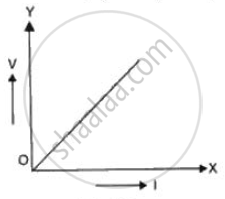
A graph is plotted taking p.d. along y-axis and electric current along x-axis. Name the physical quantity that represents the slope of this graph (Fig.).
How will you oonnect five resistors, each of the value one ohm, to obtain an equivalent resistance of 0.2 `Omega`
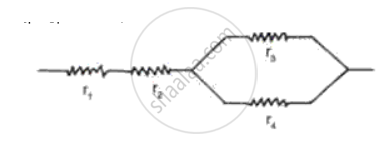
Calculate the equivalent resistance of the following combination of resistor r1, r2, r3, and r4
How does the resistance of an alloy, vary with temperature?
State expression for Resistance connected in series.
State and explain the laws of resistance.
You are provided with three resistors of resistance 1.0 Ω, 2.0 Ω and 3.0 Ω How would you connect them to obtain the total effective resistance 1.5 Ω? Draw diagram of the arrangement and check it by calculations.
Illustrate-combination of cells e.g., three cells, in series, explaining the combination briefly. Obtain an expression for current ‘i’ in the combination.
Illustrate-combination of cells e.g., three cells, in parallel, explaining the combination briefly. Obtain an expression for current ‘i’ in the combination.
If R1 and R2 be the resistance of the filament of 40 W and 60 W respectively operating 220 V, then:
Show how you would connect three resistors, each of resistance 6 Ω, so that the combination has a resistance of 4 Ω.
