Advertisements
Advertisements
प्रश्न
Find the expression for the resistors connected in series and write the two characteristics of it. (Draw figure).
Advertisements
उत्तर
Expression for the resistors in series: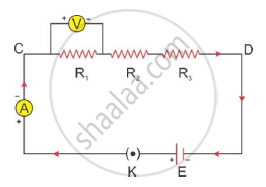
R1, R2 and R3 are the three resistors connected in series between points C and D as shown in the figure above. I is the current and V is the PD across points
C and D.
Rs is the effective resistance in a circuit, and V1, V2 and V3 are the potentials across the three resistors such that
V = V1 + V2 + V3 ---- (1)
Using Ohm’s law, the total potential difference
V = I Rs
and V1 = IR1, V2 = IR2 and V3 = IR3
Substituting these values in Equation 1, we get
IRs = IR1 + IR2 + IR3
∴ Rs = R1 + R2 + R3
For n number of resistors connected in series,
Rs = R1 + R2 + R3 + R4 + ----- + Rn
Characteristics of a series combination of resistors:
a) The same current flows through each resistor.
b) The effective resistance of the combination is greater than any of the resistances in the combination.
c) The effective resistance of the combination is equal to the sum of individual resistors.
APPEARS IN
संबंधित प्रश्न
Find the expression for resistors connected in series.
A piece of wire of resistance R is cut into five equal parts. These parts are then connected in parallel. If the equivalent resistance of this combination is R’, then the ratio `"R"/"R'"` is ______.
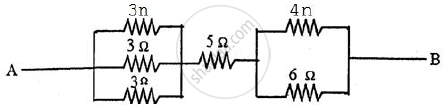
Find the equivalent resistance between points A and B
Name the material which is the best conductor of electricity.
Name the material which is used for making the heating element of an electric iron.
How does the presence of impurities in a metal affect its resistance?
Calculate the combined resistance in the given case:

Name a substance of which the resistance remains almost unchanged by the increase in temperature.
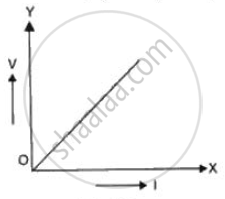
A graph is plotted taking p.d. along y-axis and electric current along x-axis. Name the physical quantity that represents the slope of this graph (Fig.).
Name the material of wire used for making standard resistances. Give a reason.
What material is used for making wire to prepare heating coils? Give a reason.
The voltage applied to a given rheostat is made four times its initial value. By what factor will be resistance of the rheostat change?
State expression for Resistance connected in parallel.
Calculate the equivalent resistance between P and Q from the following diagram:
Illustrate-combination of cells e.g., three cells, in parallel, explaining the combination briefly. Obtain an expression for current ‘i’ in the combination.
The resistance of two resistors joined in series is 8Ω and in parallel is 1.5Ω. Find the value of the two resistances.
