Advertisements
Advertisements
प्रश्न
What is an Ohmic resistor?
Advertisements
उत्तर
Ohmic resistors: The resistors which obey Ohm's law are called ohmic resistors or linear resistances.
Eg: all metallic conductors like silver, aluminium, etc. For such resistors, a graph plotted for the potential difference V against current I is a straight line and the value of resistance R is the same irrespective of the value of V or I.
i.e. V ∝ I
V = IR at constant temperature.
संबंधित प्रश्न
Will current flow more easily through a thick wire or a thin wire of the same material, when connected to the same source? Why?
Keeping the p.d. constant, the resistance of a circuit is halved. The current will become:
(a) one-fourth
(b) four time
(c) half
(d) double
The resistors R1, R2, R3 and R4 in the figure given below are all equal in value.
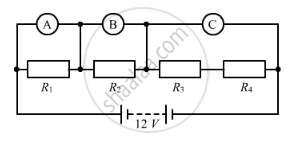
What would you expect the voltmeter A, B and C to read assuming that the connecting wires in the circuit have negligible resistance?
A resistance of 40 ohms and one of 60 ohms are arranged in series across 220 volt supply. Find the heat in joules produced by this combination of resistances in half a minute.
What are ohmic conductors? Give one exmaple. Draw a graph showing the current-voltage relationship for an ohmic conductor.
Explain the equivalent resistance of a series resistor network.
An electronics hobbyist is building a radio which requires 150 Ω in her circuit, but she has only 220 Ω, 79 Ω, and 92 Ω resistors available. How can she connect the available resistors to get the desired value of resistance?
Assertion: The statement of Ohm’s law is K = IR.
Reason: V = IR is the equation which defines resistance.
What is meant by resistance of a conductor ? Define its SI unit.
If the voltage across a conductor is increased while its temperature remains unchanged, what happens to the current flowing through it?
