Advertisements
Advertisements
प्रश्न
A wire of resistance 3 ohm and length 10 cm is stretched to length 30 cm. Assuming that it has a uniform cross section, what will be its new resistance?
Advertisements
उत्तर
Because three times the original length of the wire 10 cm is stretched to 30 cm
∴ Resistance becomes 9 times its resistance, i.e. 3 × 9 = 27 Ω
`"R"_1 = ρ 30/(a/3)`
= `9 [ρ 10/a]` ...(i)
`"R"_2 = ρ 10/a` put in (i)
R1 = 9R
= 9 × 3
= 27 Ω
∴ R = 3 Ω
APPEARS IN
संबंधित प्रश्न
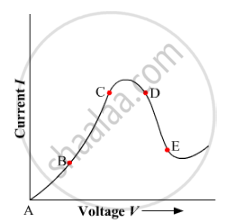
Graph showing the variation of current versus voltage for a material Ga As is shown in the figure. Identify the region of
(i) negative resistance
(ii) where Ohm's law is obeyed.
The unit of electrical resistance is:
(a) ampere
(b) volt
(c) coulomb
(d) ohm
The resistors R1, R2, R3 and R4 in the figure given below are all equal in value.
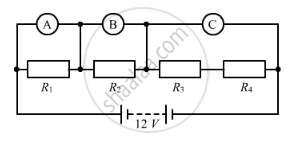
What would you expect the voltmeter A, B and C to read assuming that the connecting wires in the circuit have negligible resistance?
A wire has a length of 2.0 m and a resistance of 5.0 Ω. Find the electric field existing inside the wire if it carries a current of 10 A.
The filament of a bulb takes a current 100 mA when potential difference across it is 0.2 V. When the potential difference across it becomes 1.0 V, the current becomes 400 mA. Calculate the resistance of filament in each case and account for the difference.
The resistance of a nichrome wire at 0°C is 10Ω. If its temperature coefficient of resistivity of nichrome is 0.004/ °C, find its resistance of the wire at boiling point of water. Comment on the result.
Which of the following I-V graph represents ohmic conductors?
The temperature of a conductor is increased. The graph best showing the variation of its resistance is:
Assertion: The statement of Ohm’s law is K = IR.
Reason: V = IR is the equation which defines resistance.
How is electric current related to the potential difference across the terminals of a conductor?
Draw a labelled circuit diagram to verify this relationship.
