Advertisements
Advertisements
प्रश्न
Show by a diagram how two resistors R1 and R2 are joined in parallel. Obtain an expression for the total resistance of the combination.
Advertisements
उत्तर

On applying Ohm's law to the two resistors separately, we further
Have
`"I"_1 = "V" / "R"_1`
`"I"_2 = "V" / "R"_2`
`"I" = "I"_1 + "I"_2 `
`"V"/"R" = "V"/"R"_1+ "V"/"R"_2`
`1/"R"=1/"R"_1+1/"R"_2`
APPEARS IN
संबंधित प्रश्न
What is an Ohmic resistor?
Name the physical quantity whose unit is "ohm".
A resistance of 40 ohms and one of 60 ohms are arranged in series across 220 volt supply. Find the heat in joules produced by this combination of resistances in half a minute.
A wire of resistance 9 ohm having length 30 cm is tripled on itself. What is its new resistance?
How would you connect two resistors in series? Draw a diagram. Calculate the total equivalent resistance.
In the circuit shown below in Fig, calculate the value of x if the equivalent resistance between A and B is 4 Ω.

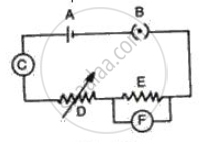
Fig. represents the circuit used for the verification of ohm's law. Label the different parts from A and F. State the function of each.
Define the following:
Coulomb
The temperature of a conductor is increased. The graph best showing the variation of its resistance is:
Two cells of same emf E but internal resistance r1 and r2 are connected in series to an external resistor R (Figure). What should be the value of R so that the potential difference across the terminals of the first cell becomes zero.
