Advertisements
Advertisements
Question
Show by a diagram how two resistors R1 and R2 are joined in parallel. Obtain an expression for the total resistance of the combination.
Advertisements
Solution

On applying Ohm's law to the two resistors separately, we further
Have
`"I"_1 = "V" / "R"_1`
`"I"_2 = "V" / "R"_2`
`"I" = "I"_1 + "I"_2 `
`"V"/"R" = "V"/"R"_1+ "V"/"R"_2`
`1/"R"=1/"R"_1+1/"R"_2`
APPEARS IN
RELATED QUESTIONS
Why are coils of electric toasters and electric irons made of an alloy rather than a pure metal?
How should the two resistances of 2 ohms each be connected so as to produce an equivalent resistance of 1 ohm?
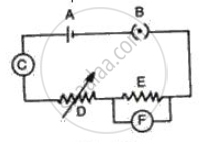
Fig. represents the circuit used for the verification of ohm's law. Label the different parts from A and F. State the function of each.
What are ohmic conductors? Give one exmaple. Draw a graph showing the current-voltage relationship for an ohmic conductor.
Draw a neat diagram for the verification of Ohm’s law by voltmeter-ammeter method. By another diagram show the relation between p.d. and current.
Answer the following question.
Distinguish between Ohmic and non-ohmic substances; explain with the help of example.
Explain the equivalent resistance of a parallel resistor network.
A student carries out an experiment and plots the V-I graph of three samples of nichrome wire with resistances R1, R2 and R3 respectively. Which of the following is true?

Two cells of same emf E but internal resistance r1 and r2 are connected in series to an external resistor R (Figure). What should be the value of R so that the potential difference across the terminals of the first cell becomes zero.
