Advertisements
Advertisements
Question
Two cells of same emf E but internal resistance r1 and r2 are connected in series to an external resistor R (Figure). What should be the value of R so that the potential difference across the terminals of the first cell becomes zero.
Advertisements
Solution
In this problem first we apply Ohm' law to find current in the circuit.
Effective emf of two cells = E + E = 2E
Effective resistance = R + r1 + r2
So the electric current is given by
`I = (E + E)/(R + r_1 + r_2)`
`V_1 = E - Ir_1 = E - (2E.r_1)/(R + r_1 + r_2)`
The net potential difference across 1st cell V1 = 0 (Given)
∴ `E - (2Er_1)/(R + r_1 + r_2)` = 0
Or `1 - (2r_1)/(R + r_1 + r_2)` = 0
`(2r_1)/(r_1 + r_2 + R) = 1/1`
Or 2r1 = r1 + r2 + R
| r1 – r2 = R |
It is the required condition for the potential difference across 1st cell to be zero.
APPEARS IN
RELATED QUESTIONS
What will be the change in the current if the potential difference is kept constant and the resistance of the circuit is made four times?
- It will remain unchanged.
- It will become four times.
- It will become one-fourth.
- It will become half.
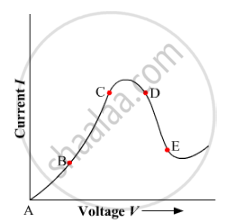
Graph showing the variation of current versus voltage for a material Ga As is shown in the figure. Identify the region of
(i) negative resistance
(ii) where Ohm's law is obeyed.
The relationship between the potential difference and the current in a conductor is stated in the form of a law.
1) Name the law.
2) What does the slope of V-I graph for a conductor represent?
3) Name the material used for making the connecting wire.
When a 12 V battery is connected across an unknown resistor, there is a current of 2.5 mA in the circuit. Calculate the value of the resistance of the resistor.
Which of the following is an ohmic resistance?
In the circuit shown below in Fig, calculate the value of x if the equivalent resistance between A and B is 4 Ω.

Calculate the electric field in a copper wire of cross-sectional area 2.0 mm2 carrying a current of 1 A.
The resistivity of copper = 1.7 × 10⁻⁸ Ω m
State and define Ohm’s law.
Ohm’s law states the relationship between power and voltage.
State Ohm’s law.
State microscopic form of Ohm’s law.
State macroscopic form of Ohm’s law.
What is non ohmic device?
Define temperature coefficient of resistance.
Write a short note on superconductors?
Explain the equivalent resistance of a parallel resistor network.
A student carries out an experiment and plots the V-I graph of three samples of nichrome wire with resistances R1, R2 and R3 respectively. Which of the following is hue?

Assertion: The statement of Ohm’s law is K = IR.
Reason: V = IR is the equation which defines resistance.
