Advertisements
Advertisements
Question
An electrical bulb is marked 200V, 100W. Calculate the electrical resistance of its filament. If five such
bulbs are connected in series to a 200V supply, how much current will flow through them?
Advertisements
Solution
Voltage V = 200 V, Power P = 100 W
∴ Electrical current = `P/V = 100/200 = 1/2` Amp
∴ Electrical resistance `R = V/I = 200/("I/2") `= 400 Ω
if five bulbs are connected in series to 200V
∴ Total resistance RT = 400 + 400 + 400 + 400 + 400 = 2000Ω
Current flowing thorugh a bulb `I = 200/2000 = 0.1 A `
APPEARS IN
RELATED QUESTIONS
Will current flow more easily through a thick wire or a thin wire of the same material, when connected to the same source? Why?
Name the unit of electrical resistance and give its symbol.
How should the two resistances of 2 ohms each be connected so as to produce an equivalent resistance of 1 ohm?
The resistors R1, R2, R3 and R4 in the figure given below are all equal in value.
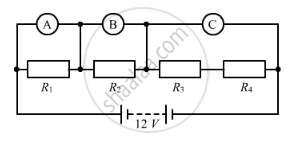
What would you expect the voltmeter A, B and C to read assuming that the connecting wires in the circuit have negligible resistance?
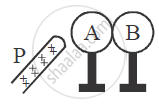
Two metallic spheres A and B kept on insulating stands are in contact with each other. A positively charged rod P is brought near the sphere A as shown in the figure. The two spheres are separated from each other, and the rod P is removed. What will be the nature of charges on spheres A and B?
Rewrite the following statement by selecting the correct option.
The S.I. unit of resistance is __________.
Define ampere and volt with respect to Ohm’s law.
An electronics hobbyist is building a radio which requires 150 Ω in her circuit, but she has only 220 Ω, 79 Ω, and 92 Ω resistors available. How can she connect the available resistors to get the desired value of resistance?
Two cells of same emf E but internal resistance r1 and r2 are connected in series to an external resistor R (Figure). What should be the value of R so that the potential difference across the terminals of the first cell becomes zero.
What is the resistance of a conductor through which a current of 0.5 A flows when a potential difference of 2V is applied across its ends?
