Advertisements
Advertisements
Question
For any prism, prove that :
'n' or `mu = sin((A + delta_m)/2)/sin(A/2)`
where the terms have their usual meaning
Advertisements
Solution
In the figure, a ray of light PQ is incident at an angle i on the face AB of prism ABC. This ray is
refracted along QR at an angle r. This reflected ray is incident on the face AC at an angle r ' and
emerges along RS at an angle i '.
In ΔQDR
`delta = (1 - r )+ (i' + r')`
`= (i + i') - (r + r')` ....(i)
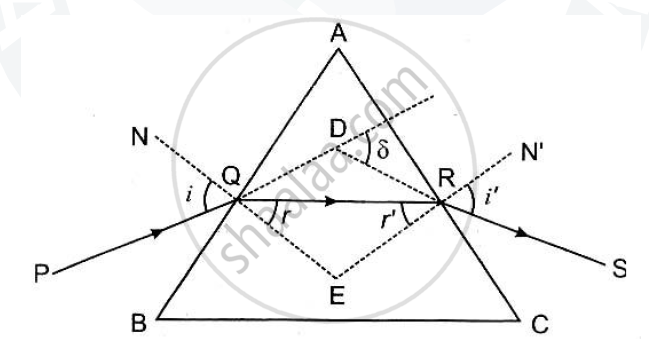
In Quad. AQER, A + E = 180° ...(ii)
In ΔQER r + r' + E = 180° ...(iii)
r + r' = A [From eq ii and iii]
Putting value r + r' inequation (i)
`delta = i + i' - A`
In the position of minimum deviation condition
`i = i', r = r', delta = delta_m`
So r + r' = A
2r = A
or `r = A/2`
`delta_m = 2i - A`
`i = (A + delta_m)/2`
Putting value of i and r from (v), (vi), in Snell’s law,
`n = sini/sin r`
`m = (sin ((A+delta_m)/2))/(sin (A/2))`
APPEARS IN
RELATED QUESTIONS
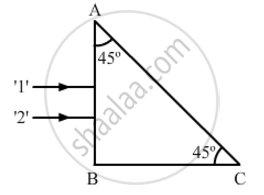
Two monochromatic rays of light are incident normally on the face AB of an isosceles right-angled prism ABC. The refractive indices of the glass prism for the two rays '1' and '2' are respectively 1.38 and 1.52. Trace the path of these rays after entering through the prism.
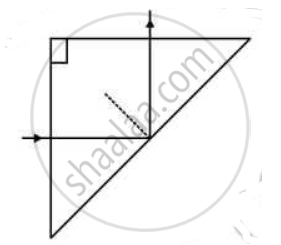
A ray of light incident normally on one face of a right isosceles prism is totally reflected, as shown in fig. What must be the minimum value of refractive index of glass? Give relevant calculations.
Draw the ray diagram showing refraction of light through a glass prism and hence obtain the relation between the refractive index μ of the prism, angle of prism and angle of minimum deviation.
Out of blue and red light which is deviated more by a prism? Give reason.
The equation \[\omega = \frac{\mu_u - \mu_r}{\mu - 1}\] was derived for a prism having small refracting angle. Is it also valid for a prism of large refracting angle? Is it also valid for a glass slab or a glass sphere?
The angular dispersion produced by a prism ___________ .
A prism can produce a minimum deviation δ in a light beam. If three such prisms are combined, the minimum deviation that can be produced in this beam is _______________.
A thin prism is made of a material having refractive indices 1.61 and 1.65 for red and violet light. The dispersive power of the material is 0.07. It is found that a beam of yellow light passing through the prism suffers a minimum deviation of 4.0° in favourable conditions. Calculate the angle of the prism.
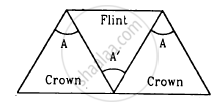
Three thin prisms are combined as shown in figure. The refractive indices of the crown glass for red, yellow and violet rays are μr, μy and μv respectively and those for the flint glass are μ'r, μ'y and μ'v respectively. Find the ratio A'/A for which (a) there is no net angular dispersion, and (b) there is no net deviation in the yellow ray.
The refractive indices of material for red, violet and yellow colour light are 1.52, 1.62 and 1.59 respectively.
Calculate the dispersive power of the material. If the mean deviation is 40°. What will be the angular dispersion produced by a prism of this material?
