Advertisements
Advertisements
Question
What is meant by the dispersive power of transparent material?
Advertisements
Solution
Dispersive power of a transparent material: When white fight is incident on a prism, it is split up into its constituent colours. Different colours are deviated through different angles. The violet colour is deviated the most and the red colour the least. Dispersive power is defined as the ratio of angular dispersion i. e., angle between the violet and red colours to the mean deviation of the mean yellow colour of fight. It is denoted by co and it depends upon the nature of the medium.
APPEARS IN
RELATED QUESTIONS
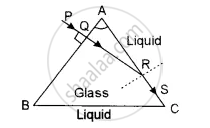
A ray PQ incident normally on the refracting face BA is refracted in the prism BAC made of material of refractive index 1.5. Complete the path of ray through the prism. From which face will the ray emerge? Justify your answer.
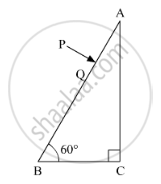
A ray of light incident normally on one face of a right isosceles prism is totally reflected, as shown in fig. What must be the minimum value of refractive index of glass? Give relevant calculations.
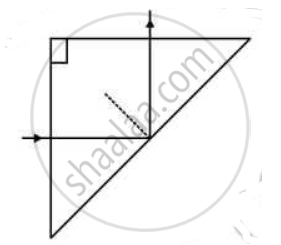
State any two difference between the primary rainbow and secondary rainbow
Give the formula that can be used to determine refractive index of materials of a prism in minimum deviation condition ?
If three identical prisms are combined, is it possible to pass a beam that emerges undeviated? Undispersed?
If a glass prism is dipped in water, its dispersive power ___________ .
A thin prism is made of a material having refractive indices 1.61 and 1.65 for red and violet light. The dispersive power of the material is 0.07. It is found that a beam of yellow light passing through the prism suffers a minimum deviation of 4.0° in favourable conditions. Calculate the angle of the prism.
Two prisms of identical geometrical shape are combined with their refracting angles oppositely directed. The materials of the prisms have refractive indices 1.52 and 1.62 for violet light. A violet ray is deviated by 1.0° when passes symmetrically through this combination. What is the angle of the prisms?
Calculate dispersive power of a transparent material given : nv = 1.56, nr = 1.54, ny = 1.55.
A narrow beam of monochromatic light, PQ, is incident normally on one face of an equiangular glass prism of refractive index 1.45. When the prism is immersed in a certain liquid, the ray makes a grazing emergence along the other face (See figure). Find the refractive index of this liquid.