Advertisements
Advertisements
Question
A current of 0.8 A flows in a conductor of 40 Ω for 1 minute. The heat produced in the conductor will be ______.
Options
1445 J
1536 J
1569 J
1640 J
Advertisements
Solution
A current of 0.8 A flows in a conductor of 40 Ω for 1 minute. The heat produced in the conductor will be 1536 J.
Explanation:
From Ohm's law, we know that
V = IR
Given: I = 0.8 A, R = 40 Ω, t = 1 min (60 sec)
Now, V = I.R
V = 0.8 × 40
V = 32 volt
Power, P = V × I
P = 32 × 0.8
P = 25.6 watt
Heat = P × t
Heat = 25.6 × 60
Heat = 1536 J
RELATED QUESTIONS
Is Ohm’s law universally applicable for all conducting elements? If not, give examples of elements which do not obey Ohm’s law.
Ohm's law gives a relationship between:
(a) current and resistance
(b) resistance and potential difference
(c) potential difference and electric charge
(d) current and potential difference
How would you connect two resistors in series? Draw a diagram. Calculate the total equivalent resistance.
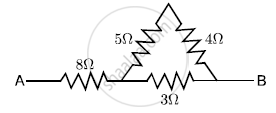
Calculate the effective resistance across AB?
Consider the sacle of voltmeter shown in the diagram and answer the following questions :

(a) What is the least count of the voltmeter?
(b) What is the reading shown by the voltmeter ?
(c) If the voltmeter is connected across a resistor of 20 `Omega` how much current is flowing through the resistor?
Draw a neat diagram for the verification of Ohm’s law by voltmeter-ammeter method. By another diagram show the relation between p.d. and current.
What is ohmic device?
How is electric current related to the potential difference across the terminals of a conductor?
Draw a labelled circuit diagram to verify this relationship.
Why should an ammeter have low resistance?
Which of the following correctly defines Potential Difference (V) as one of the three core quantities of Ohm's Law?
