Advertisements
Advertisements
Question
The circuit depicted in the figure is employed for studying Ohm’s Law. Instead of using a standard resistor, a student opts for a glass tube filled with mercury (tube 1), connected to the circuit through two electrodes, E1 and E2. He records the readings of the ammeter and voltmeter, thereby calculating the resistance. The student repeats the experiment by substituting tube 1 with tube 2, where the same amount of mercury fills tube 2.
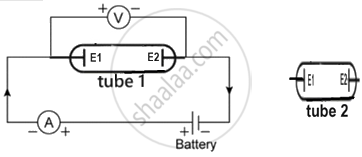
Neglecting internal resistance of the cell use (> or < or =) to compare:
- the resistance in both the cases.
- the voltmeter readings in both the cases.
- the specific resistance in both the cases.
Advertisements
Solution
- The resistance of tube 2 is less than the resistance of tube 1 because resistance depends directly on the length and inversely on the area of the resistor, and tube 2 is thicker and shorter than tube 1.
- The voltmeter reading for tube 1 is the same as the voltmeter reading for tube 2 because, according to Ohm’s law, the potential difference across a resistor depends only on the current applied, not on the resistance of the resistor.
- As the specific resistance of a resistor is independent of its dimensions but depends only on the contained material, and since here both tubes contain only mercury, the specific resistance in both cases is the same.
RELATED QUESTIONS
What will be the change in the current if the potential difference is kept constant and the resistance of the circuit is made four times?
- It will remain unchanged.
- It will become four times.
- It will become one-fourth.
- It will become half.
What is Resistivity?
Calculate the current flowing through a wire of resistance 5 Ω connected to a battery of potential difference 3 V.
In the circuit shown below in Fig, calculate the value of x if the equivalent resistance between A and B is 4 Ω.

Define the following:
Coulomb
What are ohmic conductors? Give one exmaple. Draw a graph showing the current-voltage relationship for an ohmic conductor.
What are non-ohmic conductors? Give one exmaple. Draw a current-voltage graph for a non-ohmic conductor.
A student carries out an experiment and plots the V-I graph of three samples of nichrome wire with resistances R1, R2 and R3 respectively. Which of the following is hue?

When two conductors at different electric potentials are joined by a metallic wire, in which direction do the electrons flow?
From Ohm's Law, since \[I \propto V\], the constant ratio \[\frac{V}{I}\] is defined as:
