Advertisements
Advertisements
Question
The graph between V and I for a conductor is a straight line passing through the origin.
- Which law is illustrated by such a graph?
- What should remain constant in a statement of this law?
Advertisements
Solution
- Ohm’s law states that the graph between V and I for a conductor is a straight line passing through the origin.
- Temperature should remain constant in this statement of the law.
APPEARS IN
RELATED QUESTIONS
Let the resistance of an electrical component remains constant while the potential difference across the two ends of the component decreases to half of its former value. What change will occur in the current through it?
Write the formula of resistivity
Name the law which is illustrated by the above V−I graph.
The unit of electrical resistance is:
(a) ampere
(b) volt
(c) coulomb
(d) ohm
Keeping the p.d. constant, the resistance of a circuit is halved. The current will become:
(a) one-fourth
(b) four time
(c) half
(d) double
Which of the following is an ohmic resistance?
In the circuit shown in the figure, find the total resistance of the circuit and the current in the arm AD.
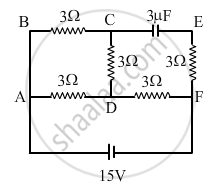
Choose the correct alternative.
Which of the following is an ohmic conductor?
What is non ohmic device?
An electronics hobbyist is building a radio which requires 150 Ω in her circuit, but she has only 220 Ω, 79 Ω, and 92 Ω resistors available. How can she connect the available resistors to get the desired value of resistance?
Two cells of same emf E but internal resistance r1 and r2 are connected in series to an external resistor R (Figure). What should be the value of R so that the potential difference across the terminals of the first cell becomes zero.
What is the resistance of a conductor through which a current of 0.5 A flows when a potential difference of 2V is applied across its ends?
A current of 0.8 A flows in a conductor of 40 Ω for 1 minute. The heat produced in the conductor will be ______.
The voltage - current readings of a certain material are shown in the table given below:
| Voltage (V) | 10 V | 20 V | 30 V |
| Current (I) | 2 A | 3 A | 4 A |
Study the table.
- State whether the conductor used is ohmic or non-ohmic.
- Justify your answer.
- State Ohm's law.
A current of 3.2 mA flows through a conductor. If charge on an electron is −1.6 × 10⁻¹⁹ coulomb, find the number of electrons that will pass each second through the cross section of that conductor.
Which of the following correctly defines Potential Difference (V) as one of the three core quantities of Ohm's Law?
If the voltage across a conductor is increased while its temperature remains unchanged, what happens to the current flowing through it?
