Advertisements
Advertisements
प्रश्न
The graph between V and I for a conductor is a straight line passing through the origin.
- Which law is illustrated by such a graph?
- What should remain constant in a statement of this law?
Advertisements
उत्तर
- Ohm’s law states that the graph between V and I for a conductor is a straight line passing through the origin.
- Temperature should remain constant in this statement of the law.
APPEARS IN
संबंधित प्रश्न
Let the resistance of an electrical component remains constant while the potential difference across the two ends of the component decreases to half of its former value. What change will occur in the current through it?
Write the formula of resistivity
Find the expression for the resistivity of a material and state the SI unit of resistivity.
Name the law which is illustrated by the above V−I graph.
The resistors R1, R2, R3 and R4 in the figure given below are all equal in value.
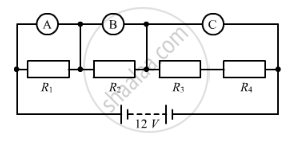
What would you expect the voltmeter A, B and C to read assuming that the connecting wires in the circuit have negligible resistance?
Four resistances of 16 ohms each are connected in parallel. Four such combinations are connected in series. What is the total resistance?
What is the necessary condition for a conductor to obey Ohm’s law?
An electric bulb draws 1.2 A current at 6.0 V. Find the resistance of filament of bulb while glowing.
In an experiment of verification of Ohm’s law following observations are obtained.
|
Potential difference V (in volt) |
0.5 | 1.0 | 1.5 | 2.0 | 2.5 |
| current I (in ampere) | 0.2 | 0.4 | 0.6 | 0.8 | 1.0 |
Draw a V-I graph and use this graph to find:
- the potential difference V when the current I is 0.5 A,
- the current I when the potential difference V is 0.75 V,
- the resistance in a circuit.
How does an increase in the temperature affect the specific resistance of a semiconductor?
An ammeter placed in series with an electric radiator reads 0.5 amps and a voltmeter placed across it reads 230 volts. What is the resistance of the radiator?
The ratio of the potential difference to the current is known as ________.
Explain the equivalent resistance of a parallel resistor network.
A student carries out an experiment and plots the V-I graph of three samples of nichrome wire with resistances R1, R2 and R3 respectively. Which of the following is hue?

Consider a current carrying wire (current I) in the shape of a circle. Note that as the current progresses along the wire, the direction of j (current density) changes in an exact manner, while the current I remain unaffected. The agent that is essentially responsible for is ______.
A metal rod of length 10 cm and a rectangular cross-section of 1 cm × `1/2` cm is connected to a battery across opposite faces. The resistance will be ______.
Two cells of same emf E but internal resistance r1 and r2 are connected in series to an external resistor R (Figure). What should be the value of R so that the potential difference across the terminals of the first cell becomes zero.
State Ohm's Law. Represent it mathematically.
What is meant by resistance of a conductor ? Define its SI unit.
