Advertisements
Advertisements
प्रश्न
In an experiment of verification of Ohm’s law following observations are obtained.
|
Potential difference V (in volt) |
0.5 | 1.0 | 1.5 | 2.0 | 2.5 |
| current I (in ampere) | 0.2 | 0.4 | 0.6 | 0.8 | 1.0 |
Draw a V-I graph and use this graph to find:
- the potential difference V when the current I is 0.5 A,
- the current I when the potential difference V is 0.75 V,
- the resistance in a circuit.
Advertisements
उत्तर

- 1.25 V
- 0.3 A
- The graph is linear, so resistance can be found from any value of the given table. For instance:
When V = 2.5 Volt
Current is I = 1.0 amp
According to ohm's law:
R = `"V"/"I"`
R = `2.5/1.0`
R = 2.5 Ω
APPEARS IN
संबंधित प्रश्न
Will current flow more easily through a thick wire or a thin wire of the same material, when connected to the same source? Why?
An electrical bulb is marked 200V, 100W. Calculate the electrical resistance of its filament. If five such
bulbs are connected in series to a 200V supply, how much current will flow through them?
Four resistances of 16 ohms each are connected in parallel. Four such combinations are connected in series. What is the total resistance?
Which of the following is an ohmic resistance?
A wire of resistance 3 ohm and length 10 cm is stretched to length 30 cm. Assuming that it has a uniform cross section, what will be its new resistance?
What length of copper wire of resistivity 1.7 × 10⁻⁸ Ω m and radius 1 mm is required so that its resistance is 2Ω?
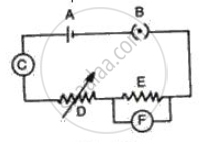
Fig. represents the circuit used for the verification of ohm's law. Label the different parts from A and F. State the function of each.
Assertion: The statement of Ohm’s law is K = IR.
Reason: V = IR is the equation which defines resistance.
State Ohm’s law? How can it be verified experimentally? Does it hold good under all conditions? Comment.
Why should an ammeter have low resistance?
