Advertisements
Advertisements
प्रश्न
Calculate the current flowing through a wire of resistance 5 Ω connected to a battery of potential difference 3 V.
Advertisements
उत्तर
Potential Difference/Voltage (V) = 3 V
Resistance (R) = 5Ω
Current (I) = ?
According to Ohm's Law:
V = IR
Then I = `"V"/"R"`
I = `3/5`
= 0.6 A
APPEARS IN
संबंधित प्रश्न
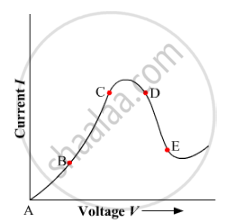
Graph showing the variation of current versus voltage for a material Ga As is shown in the figure. Identify the region of
(i) negative resistance
(ii) where Ohm's law is obeyed.
When a 12 V battery is connected across an unknown resistor, there is a current of 2.5 mA in the circuit. Find the value of the resistance of the resistor.
The relationship between the potential difference and the current in a conductor is stated in the form of a law.
- Name the law.
- What does the slope of V-I graph for a conductor represent?
- Name the material used for making the connecting wire.
Find the expression for the resistivity of a material and state the SI unit of resistivity.
The unit of electrical resistance is:
(a) ampere
(b) volt
(c) coulomb
(d) ohm
Keeping the p.d. constant, the resistance of a circuit is halved. The current will become:
(a) one-fourth
(b) four time
(c) half
(d) double
What is non ohmic device?
Define temperature coefficient of resistance.
A current of 2amp flowing through a conductor produced 80 joule of heat in 10 sec. The resistance of the conductor is:-
If the voltage across a conductor is increased while its temperature remains unchanged, what happens to the current flowing through it?
