Advertisements
Advertisements
प्रश्न
Name the law which is illustrated by the above V−I graph.
Advertisements
उत्तर
Ohm's law is illustrated by the above V−I graph.
संबंधित प्रश्न
What will be the change in the current if the potential difference is kept constant and the resistance of the circuit is made four times?
- It will remain unchanged.
- It will become four times.
- It will become one-fourth.
- It will become half.
Find the resistance of a conductor if 0.24 A current is passing through it and a potential difference of 24 V is applied across it.
A low voltage supply from which one needs high currents must have very low internal resistance. Why?
An electrical bulb is marked 200V, 100W. Calculate the electrical resistance of its filament. If five such
bulbs are connected in series to a 200V supply, how much current will flow through them?
Name the physical quantity whose unit is "ohm".
Keeping the p.d. constant, the resistance of a circuit is halved. The current will become:
(a) one-fourth
(b) four time
(c) half
(d) double
The resistors R1, R2, R3 and R4 in the figure given below are all equal in value.
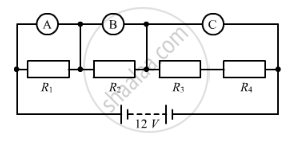
What would you expect the voltmeter A, B and C to read assuming that the connecting wires in the circuit have negligible resistance?
A resistance of 40 ohms and one of 60 ohms are arranged in series across 220 volt supply. Find the heat in joules produced by this combination of resistances in half a minute.
In a conductor 6.25 × `10^16` electrons flow from its end A to B in 2 s. Find the current flowing through the conductor (e = 1.6 × `10^-19` C)
Calculate the effective resistance across AB?
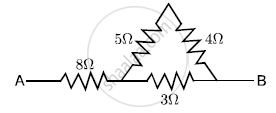
The filament of a bulb takes a current 100 mA when potential difference across it is 0.2 V. When the potential difference across it becomes 1.0 V, the current becomes 400 mA. Calculate the resistance of filament in each case and account for the difference.
Two cells each of 5V are connected in series across an 8Ω resistor and three parallel resistors of 4Ω, 6Ω, and 12Ω. Draw a circuit diagram for the above arrangement. Calculate
- the current drawn from the cell
- current through each resistor
Which of the following I-V graph represents ohmic conductors?
A student carries out an experiment and plots the V-I graph of three samples of nichrome wire with resistances R1, R2 and R3 respectively. Which of the following is hue?

Let the resistance of an electrical device remain constant, while the potential difference across its two ends decreases to one fourth of its initial value. What change will occur in the current through it? State the law which helps us in solving the above stated question.
How is electric current related to the potential difference across the terminals of a conductor?
Draw a labelled circuit diagram to verify this relationship.
Why should an ammeter have low resistance?
The mathematical form of Ohm's Law is:
In which unit is the resistance of a conductor measured?
If a current of 1 A flows through a conductor, then according to Ohm's Law, the resistance of the conductor is:
