Advertisements
Advertisements
प्रश्न
The circuit depicted in the figure is employed for studying Ohm’s Law. Instead of using a standard resistor, a student opts for a glass tube filled with mercury (tube 1), connected to the circuit through two electrodes, E1 and E2. He records the readings of the ammeter and voltmeter, thereby calculating the resistance. The student repeats the experiment by substituting tube 1 with tube 2, where the same amount of mercury fills tube 2.
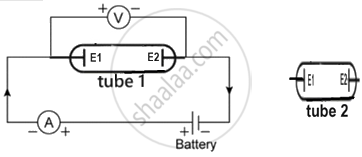
Neglecting internal resistance of the cell use (> or < or =) to compare:
- the resistance in both the cases.
- the voltmeter readings in both the cases.
- the specific resistance in both the cases.
Advertisements
उत्तर
- The resistance of tube 2 is less than the resistance of tube 1 because resistance depends directly on the length and inversely on the area of the resistor, and tube 2 is thicker and shorter than tube 1.
- The voltmeter reading for tube 1 is the same as the voltmeter reading for tube 2 because, according to Ohm’s law, the potential difference across a resistor depends only on the current applied, not on the resistance of the resistor.
- As the specific resistance of a resistor is independent of its dimensions but depends only on the contained material, and since here both tubes contain only mercury, the specific resistance in both cases is the same.
संबंधित प्रश्न
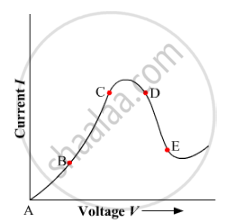
Graph showing the variation of current versus voltage for a material Ga As is shown in the figure. Identify the region of
(i) negative resistance
(ii) where Ohm's law is obeyed.
Write the formula of resistivity
Ohm's law gives a relationship between:
(a) current and resistance
(b) resistance and potential difference
(c) potential difference and electric charge
(d) current and potential difference
How should the two resistances of 2 ohms each be connected so as to produce an equivalent resistance of 1 ohm?
What is non ohmic device?
Two cells each of 5V are connected in series across an 8Ω resistor and three parallel resistors of 4Ω, 6Ω, and 12Ω. Draw a circuit diagram for the above arrangement. Calculate
- the current drawn from the cell
- current through each resistor
State Ohm’s law? How can it be verified experimentally? Does it hold good under all conditions? Comment.
A current of 3.2 mA flows through a conductor. If charge on an electron is −1.6 × 10⁻¹⁹ coulomb, find the number of electrons that will pass each second through the cross section of that conductor.
For a continuous current flow through a conductor, what must be maintained across the ends of the conductor?
What is the nature of the graph obtained when potential difference is plotted against current for an Ohmic conductor?
