Advertisements
Advertisements
प्रश्न
The circuit depicted in the figure is employed for studying Ohm’s Law. Instead of using a standard resistor, a student opts for a glass tube filled with mercury (tube 1), connected to the circuit through two electrodes, E1 and E2. He records the readings of the ammeter and voltmeter, thereby calculating the resistance. The student repeats the experiment by substituting tube 1 with tube 2, where the same amount of mercury fills tube 2.
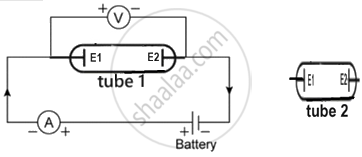
Neglecting internal resistance of the cell use (> or < or =) to compare:
- the resistance in both the cases.
- the voltmeter readings in both the cases.
- the specific resistance in both the cases.
Advertisements
उत्तर
- The resistance of tube 2 is less than the resistance of tube 1 because resistance depends directly on the length and inversely on the area of the resistor, and tube 2 is thicker and shorter than tube 1.
- The voltmeter reading for tube 1 is the same as the voltmeter reading for tube 2 because, according to Ohm’s law, the potential difference across a resistor depends only on the current applied, not on the resistance of the resistor.
- As the specific resistance of a resistor is independent of its dimensions but depends only on the contained material, and since here both tubes contain only mercury, the specific resistance in both cases is the same.
संबंधित प्रश्न
The relationship between the potential difference and the current in a conductor is stated in the form of a law.
- Name the law.
- What does the slope of V-I graph for a conductor represent?
- Name the material used for making the connecting wire.
Write the SI unit of resistivity
When a 12 V battery is connected across an unknown resistor, there is a current of 2.5 mA in the circuit. Calculate the value of the resistance of the resistor.
A resistance of 40 ohms and one of 60 ohms are arranged in series across 220 volt supply. Find the heat in joules produced by this combination of resistances in half a minute.
In a conductor 6.25 × `10^16` electrons flow from its end A to B in 2 s. Find the current flowing through the conductor (e = 1.6 × `10^-19` C)
What length of copper wire of resistivity 1.7 × 10⁻⁸ Ω m and radius 1 mm is required so that its resistance is 2Ω?
Define ampere and volt with respect to Ohm’s law.
Choose the correct alternative.
Which of the following is an ohmic conductor?
State Ohm’s law.
The resistance of a nichrome wire at 0°C is 10Ω. If its temperature coefficient of resistivity of nichrome is 0.004/ °C, find its resistance of the wire at boiling point of water. Comment on the result.
