Advertisements
Advertisements
प्रश्न
Name the law which is illustrated by the above V−I graph.
Advertisements
उत्तर
Ohm's law is illustrated by the above V−I graph.
संबंधित प्रश्न
What will be the change in the current if the potential difference is kept constant and the resistance of the circuit is made four times?
- It will remain unchanged.
- It will become four times.
- It will become one-fourth.
- It will become half.
Write the formula of resistivity
Write the SI unit of resistivity
Name the physical quantity whose unit is "ohm".
A resistance of 40 ohms and one of 60 ohms are arranged in series across 220 volt supply. Find the heat in joules produced by this combination of resistances in half a minute.
In the circuit shown below in Fig, calculate the value of x if the equivalent resistance between A and B is 4 Ω.

Calculate the electric field in a copper wire of cross-sectional area 2.0 mm2 carrying a current of 1 A.
The resistivity of copper = 1.7 × 10⁻⁸ Ω m
Two metallic spheres A and B kept on insulating stands are in contact with each other. A positively charged rod P is brought near the sphere A as shown in the figure. The two spheres are separated from each other, and the rod P is removed. What will be the nature of charges on spheres A and B?
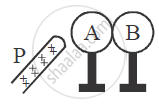
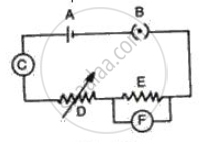
Fig. represents the circuit used for the verification of ohm's law. Label the different parts from A and F. State the function of each.
Define ampere and volt with respect to Ohm’s law.
State the limitations of Ohm’s law.
Answer the following question.
Distinguish between Ohmic and non-ohmic substances; explain with the help of example.
Explain the equivalent resistance of a parallel resistor network.
Consider a current carrying wire (current I) in the shape of a circle. Note that as the current progresses along the wire, the direction of j (current density) changes in an exact manner, while the current I remain unaffected. The agent that is essentially responsible for is ______.
State Ohm's Law. Represent it mathematically.
You are provided with a resistor, a key, an ammeter, a voltmeter, four cells of 1.5 V each and few connecting wires. Using circuit components, draw a labelled circuit diagram to show the setup to study Ohm's law.
State the relationship between potential difference (V) across the resistor and the current (I) flowing through it. Also draw V-I graph, taking V on the X-axis.
A current of 0.8 A flows in a conductor of 40 Ω for 1 minute. The heat produced in the conductor will be ______.
The circuit depicted in the figure is employed for studying Ohm’s Law. Instead of using a standard resistor, a student opts for a glass tube filled with mercury (tube 1), connected to the circuit through two electrodes, E1 and E2. He records the readings of the ammeter and voltmeter, thereby calculating the resistance. The student repeats the experiment by substituting tube 1 with tube 2, where the same amount of mercury fills tube 2.
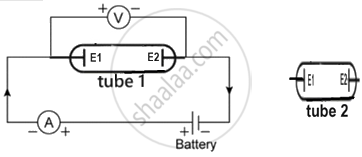
Neglecting internal resistance of the cell use (> or < or =) to compare:
- the resistance in both the cases.
- the voltmeter readings in both the cases.
- the specific resistance in both the cases.
The electric current between two joined conductors at different potentials continues to flow until:
What is the nature of the graph obtained when potential difference is plotted against current for an Ohmic conductor?
