Advertisements
Advertisements
प्रश्न
The voltage - current readings of a certain material are shown in the table given below:
| Voltage (V) | 10 V | 20 V | 30 V |
| Current (I) | 2 A | 3 A | 4 A |
Study the table.
- State whether the conductor used is ohmic or non-ohmic.
- Justify your answer.
- State Ohm's law.
Advertisements
उत्तर
a. Here, the ratio of `V/1` for different readings is:
(i) `(10 V)/(2 A) = 5 Ω`
(ii) `(20 V)/(3 A) = 6.66 Ω`
(iii) `(30 V)/(4 A) = 7.5 Ω`
Here, the ratio is not constant, so the conductor is non-ohmic.
b. The ratio of `V/I` remains constant for all values of V and I in an ohmic conductor. Plotting current I against potential difference V results in a straight line that passes through the origin on a graph. Thus, the conductor in question is not ohmic.
c. Ohm's law states that, under constant physical conditions and conductor temperature, the current flowing in a conductor is directly proportional to the potential difference applied across its ends.
संबंधित प्रश्न
Graph showing the variation of current versus voltage for a material Ga As is shown in the figure. Identify the region of
(i) negative resistance
(ii) where Ohm's law is obeyed.
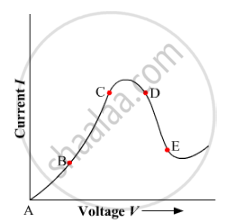
An electric bulb draws 1.2 A current at 6.0 V. Find the resistance of filament of bulb while glowing.
State the relation correlating the electric current flowing in a conductor and the voltage applied across it. Also, draw a graph to show this relationship.
What are ohmic conductors? Give one exmaple. Draw a graph showing the current-voltage relationship for an ohmic conductor.
Answer the following question.
Distinguish between Ohmic and non-ohmic substances; explain with the help of example.

Calculate the total resistance of the circuit and find the total current in the circuit.
Two conductors are made of the same material and have the same length. Conductor A is a solid wire of diameter 1 mm. Conductor B is a hollow tube of outer diameter 2 mm and inner diameter 1 mm. Find the ratio of resistance RA to RB.
Let the resistance of an electrical device remain constant, while the potential difference across its two ends decreases to one fourth of its initial value. What change will occur in the current through it? State the law which helps us in solving the above stated question.
Ohm's Law states that for a metallic conductor, the current flowing through it is directly proportional to the potential difference across its ends, provided that:
The mathematical form of Ohm's Law is:
