Advertisements
Advertisements
प्रश्न
Two conductors are made of the same material and have the same length. Conductor A is a solid wire of diameter 1 mm. Conductor B is a hollow tube of outer diameter 2 mm and inner diameter 1 mm. Find the ratio of resistance RA to RB.
Advertisements
उत्तर
We know that the resistance of wire is `R = ρ l/A` where A is cross-sectional area of conductor and ρ is the specific resistance or resistivity and L is the length of conductor.
The resistance of first conductor
`R_A = (ρl)/(pi(10^-3 xx 0.5)^2`
The resistance of second conductor,
`R_B = (ρl)/(pi[(10^-3)^2 - (0.5 xx 10^-3)^2]`
Now, the ratio of two resistors is given by
`R_A/R_B = ((10^-3)^2 - (0.5 xx 10^-3)^2)/(0.5 xx 10^-3)^2` = 3:1
APPEARS IN
संबंधित प्रश्न
Find the resistance of a conductor if 0.24 A current is passing through it and a potential difference of 24 V is applied across it.
Is Ohm’s law universally applicable for all conducting elements? If not, give examples of elements which do not obey Ohm’s law.
What is Resistivity?
Name the law which is illustrated by the above V−I graph.
The resistors R1, R2, R3 and R4 in the figure given below are all equal in value.
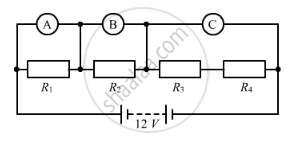
What would you expect the voltmeter A, B and C to read assuming that the connecting wires in the circuit have negligible resistance?
What is the necessary condition for a conductor to obey Ohm’s law?
What is an ohmic resistor? Give one example of an ohmic resistor. Draw a graph to show its current voltage relationship. How is the resistance of the resistor determined from this graph?
Which of the following is an ohmic resistance?
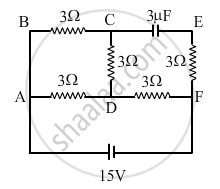
In the circuit shown in the figure, find the total resistance of the circuit and the current in the arm AD.
Calculate the electric field in a copper wire of cross-sectional area 2.0 mm2 carrying a current of 1 A.
The resistivity of copper = 1.7 × 10⁻⁸ Ω m
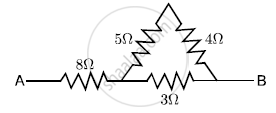
Calculate the effective resistance across AB?
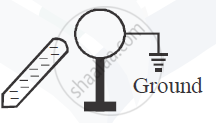
A metal sphere is kept on an insulting stands. A negatively charged rod is brought near it, then the sphere is earthed as shown. On removing the earthing, and taking the negatively charged rod away, what will be the nature of charge on the sphere? Give reason for your answer.
- Name and state the law which relates the potential difference and current in a conductor.
- What is the necessary condition for a conductor to obey the law named above in part (a) ?
Rewrite the following statement by selecting the correct option.
The S.I. unit of resistance is __________.
Define Current density.
The slope of voltage (V) versus current (I) is called:

The temperature of a conductor is increased. The graph best showing the variation of its resistance is:
