Advertisements
Advertisements
प्रश्न
Define Current density.
Advertisements
उत्तर
Current density is a vector quantity, often known as an area vector or cross-sectional area vector, whose value is equal to the electric current flowing per unit area.
J = `"I"/"A"`
S.I unit is A/m2.
APPEARS IN
संबंधित प्रश्न
What is an Ohmic resistor?
What is Resistivity?
Name the unit of electrical resistance and give its symbol.
Keeping the p.d. constant, the resistance of a circuit is halved. The current will become:
(a) one-fourth
(b) four time
(c) half
(d) double
The resistors R1, R2, R3 and R4 in the figure given below are all equal in value.
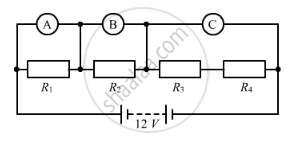
What would you expect the voltmeter A, B and C to read assuming that the connecting wires in the circuit have negligible resistance?
Four resistances of 16 ohms each are connected in parallel. Four such combinations are connected in series. What is the total resistance?
In a conductor 6.25 × `10^16` electrons flow from its end A to B in 2 s. Find the current flowing through the conductor (e = 1.6 × `10^-19` C)
Calculate the current flowing through a wire of resistance 5 Ω connected to a battery of potential difference 3 V.
What is meant by the drift speed of free electrons?
State and define Ohm’s law.
State the limitations of Ohm’s law.
State macroscopic form of Ohm’s law.
State Ohm’s law? How can it be verified experimentally? Does it hold good under all conditions? Comment.
Suppose there is a circuit consisting of only resistances and batteries and we have to double (or increase it to n-times) all voltages and all resistances. Show that currents are unaltered. Do this for circuit of Example 3.7 in the NCERT Text Book for Class XII.
What is meant by resistance of a conductor ? Define its SI unit.
A current of 3.2 mA flows through a conductor. If charge on an electron is −1.6 × 10⁻¹⁹ coulomb, find the number of electrons that will pass each second through the cross section of that conductor.
When two conductors at different electric potentials are joined by a metallic wire, in which direction do the electrons flow?
Which of the following is an example of a Non-Ohmic material?
If the voltage across a conductor is increased while its temperature remains unchanged, what happens to the current flowing through it?
