Advertisements
Advertisements
प्रश्न
Keeping the p.d. constant, the resistance of a circuit is halved. The current will become:
(a) one-fourth
(b) four time
(c) half
(d) double
Advertisements
उत्तर
d) double
As we know from Ohm’s law:
Voltage = Current x Resistance
V = IR
If the voltage is constant, the resistance of the circuit is halved. That is, it becomes R / 2.
Current, I = V/R
I = V/R
I = V/R/2 = 2 I
Thus by keeping the p.d. constant, the resistance of a circuit is halved and the current is doubled.
APPEARS IN
संबंधित प्रश्न
Why are coils of electric toasters and electric irons made of an alloy rather than a pure metal?
What is Resistivity?
An electrical bulb is marked 200V, 100W. Calculate the electrical resistance of its filament. If five such
bulbs are connected in series to a 200V supply, how much current will flow through them?
When a 12 V battery is connected across an unknown resistor, there is a current of 2.5 mA in the circuit. Calculate the value of the resistance of the resistor.
Ohm's law gives a relationship between:
(a) current and resistance
(b) resistance and potential difference
(c) potential difference and electric charge
(d) current and potential difference
The resistors R1, R2, R3 and R4 in the figure given below are all equal in value.
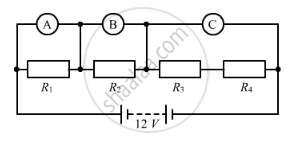
What would you expect the voltmeter A, B and C to read assuming that the connecting wires in the circuit have negligible resistance?
Calculate the electric field in a copper wire of cross-sectional area 2.0 mm2 carrying a current of 1 A.
The resistivity of copper = 1.7 × 10⁻⁸ Ω m
Tick(✓) the correct choice in the following:
Ohm's law is applicable to
What is meant by the drift speed of free electrons?
Ohm’s law states the relationship between power and voltage.
Define Current density.
Define temperature coefficient of resistance.
A metal rod of length 10 cm and a rectangular cross-section of 1 cm × `1/2` cm is connected to a battery across opposite faces. The resistance will be ______.
Two conductors are made of the same material and have the same length. Conductor A is a solid wire of diameter 1 mm. Conductor B is a hollow tube of outer diameter 2 mm and inner diameter 1 mm. Find the ratio of resistance RA to RB.
What is meant by resistance of a conductor ? Define its SI unit.
The circuit depicted in the figure is employed for studying Ohm’s Law. Instead of using a standard resistor, a student opts for a glass tube filled with mercury (tube 1), connected to the circuit through two electrodes, E1 and E2. He records the readings of the ammeter and voltmeter, thereby calculating the resistance. The student repeats the experiment by substituting tube 1 with tube 2, where the same amount of mercury fills tube 2.
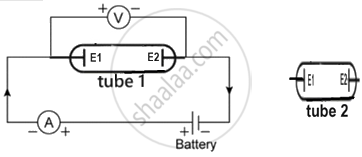
Neglecting internal resistance of the cell use (> or < or =) to compare:
- the resistance in both the cases.
- the voltmeter readings in both the cases.
- the specific resistance in both the cases.
In the context of Ohm's Law, Current (I) is defined as:
When two conductors at different electric potentials are joined by a metallic wire, in which direction do the electrons flow?
From Ohm's Law, since \[I \propto V\], the constant ratio \[\frac{V}{I}\] is defined as:
