Advertisements
Advertisements
प्रश्न
Keeping the p.d. constant, the resistance of a circuit is halved. The current will become:
(a) one-fourth
(b) four time
(c) half
(d) double
Advertisements
उत्तर
d) double
As we know from Ohm’s law:
Voltage = Current x Resistance
V = IR
If the voltage is constant, the resistance of the circuit is halved. That is, it becomes R / 2.
Current, I = V/R
I = V/R
I = V/R/2 = 2 I
Thus by keeping the p.d. constant, the resistance of a circuit is halved and the current is doubled.
APPEARS IN
संबंधित प्रश्न
What will be the change in the current if the potential difference is kept constant and the resistance of the circuit is made four times?
- It will remain unchanged.
- It will become four times.
- It will become one-fourth.
- It will become half.
Find the resistance of a conductor if 0.24 A current is passing through it and a potential difference of 24 V is applied across it.
Name the law which is illustrated by the above V−I graph.
What is the necessary condition for a conductor to obey Ohm’s law?
Calculate the current flowing through a wire of resistance 5 Ω connected to a battery of potential difference 3 V.
A wire has a length of 2.0 m and a resistance of 5.0 Ω. Find the electric field existing inside the wire if it carries a current of 10 A.
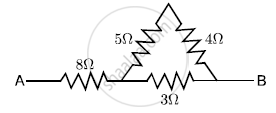
Calculate the effective resistance across AB?
What is non-ohmic resistor?
SI unit of resistance is:
A wire connected to a power supply of 230 V has power dissipation P1. Suppose the wire is cut into two equal pieces and connected parallel to the same power supply. In this case, power dissipation is P2. The ratio of `"P"_2/"P"_1` is
What is ohmic device?
Define temperature coefficient of resistance.
Which of the following is correct for V-I graph of a good conductor?

Calculate the total resistance of the circuit and find the total current in the circuit.
You are provided with a resistor, a key, an ammeter, a voltmeter, four cells of 1.5 V each and few connecting wires. Using circuit components, draw a labelled circuit diagram to show the setup to study Ohm's law.
State the relationship between potential difference (V) across the resistor and the current (I) flowing through it. Also draw V-I graph, taking V on the X-axis.
Why should an ammeter have low resistance?
The mathematical form of Ohm's Law is:
For a continuous current flow through a conductor, what must be maintained across the ends of the conductor?
Which of the following describes the V-I relation for an Ohmic conductor?
