Advertisements
Advertisements
प्रश्न
A wire has a length of 2.0 m and a resistance of 5.0 Ω. Find the electric field existing inside the wire if it carries a current of 10 A.
Advertisements
उत्तर
Given:-
Length of the wire, l = 2 m
Resistance of the wire, R = 5 Ω
Current through the wire, i = 10 A
From Ohm's Law, the potential difference across the wire,
V = iR
∴ V= 10 × 5 = 50 V
Electric field,
\[E = \frac{V}{l}\]
\[ = \frac{50}{2}\]
\[ = 25 V/m\]
APPEARS IN
संबंधित प्रश्न
Let the resistance of an electrical component remains constant while the potential difference across the two ends of the component decreases to half of its former value. What change will occur in the current through it?
When a 12 V battery is connected across an unknown resistor, there is a current of 2.5 mA in the circuit. Find the value of the resistance of the resistor.
When a 12 V battery is connected across an unknown resistor, there is a current of 2.5 mA in the circuit. Calculate the value of the resistance of the resistor.
The unit of electrical resistance is:
(a) ampere
(b) volt
(c) coulomb
(d) ohm
How should the two resistances of 2 ohms each be connected so as to produce an equivalent resistance of 1 ohm?
A car bulb connected to a 12 volt battery draws 2 A current when glowing. What is the resistance of the filament of the bulb? Will the resistance be more same or less when the bulb is not glowing?
A wire of resistance 9 ohm having length 30 cm is tripled on itself. What is its new resistance?
Tick(✓) the correct choice in the following:
Ohm's law is applicable to
Define the following:
Coulomb
Fig. represents the circuit used for the verification of Ohm's law. Label the parts from A to F. state the function of each.
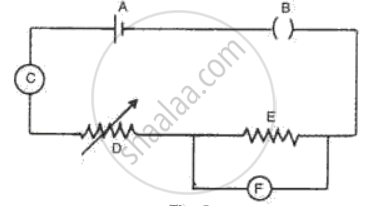
- Name and state the law which relates the potential difference and current in a conductor.
- What is the necessary condition for a conductor to obey the law named above in part (a) ?
Which of the following I-V graph represents ohmic conductors?
State Ohm’s law? How can it be verified experimentally? Does it hold good under all conditions? Comment.
The heat produced by a 100 w heater in 2 minute is equal to
Two conductors are made of the same material and have the same length. Conductor A is a solid wire of diameter 1 mm. Conductor B is a hollow tube of outer diameter 2 mm and inner diameter 1 mm. Find the ratio of resistance RA to RB.
State Ohm's Law. Represent it mathematically.
Why should an ammeter have low resistance?
In the context of Ohm's Law, Current (I) is defined as:
In which unit is the resistance of a conductor measured?
If a current of 1 A flows through a conductor, then according to Ohm's Law, the resistance of the conductor is:
