Advertisements
Advertisements
प्रश्न
Answer the following question.
Distinguish between Ohmic and non-ohmic substances; explain with the help of example.
Advertisements
उत्तर
| Ohmic substances | Non-ohmic substances |
| 1. Substances which obey ohm’s law are called ohmic substances | 1. Substances which do not obey ohm’s law are called non-ohmic substances. |
| 2. Potential difference (V) versus current (I) curve is a straight line. | 2. Potential difference (V) versus current (I) curve is not a straight line. |
| 3. Resistance of these substances is constant i.e. they follow linear I-V characteristic. | 3. Resistance of these substances is a function of V or I. |
| 4. Expression for resistance is, R = `"V"/"I"` | 4. Expression for resistance is, R = `lim_(Δ"l"→0)(Δ"V")/(Δ"I")="dV"/"dI"` |
| 5. Examples: Gold, silver, copper etc. | 5. Examples: Liquid electrolytes, vacuum tubes, junction diodes, thermistors etc. |
APPEARS IN
संबंधित प्रश्न
Find the resistance of a conductor if 0.24 A current is passing through it and a potential difference of 24 V is applied across it.
Will current flow more easily through a thick wire or a thin wire of the same material, when connected to the same source? Why?
What is Resistivity?
An electrical bulb is marked 200V, 100W. Calculate the electrical resistance of its filament. If five such
bulbs are connected in series to a 200V supply, how much current will flow through them?
How should the two resistances of 2 ohms each be connected so as to produce an equivalent resistance of 1 ohm?
Four resistances of 16 ohms each are connected in parallel. Four such combinations are connected in series. What is the total resistance?
An electric bulb draws 1.2 A current at 6.0 V. Find the resistance of filament of bulb while glowing.
A car bulb connected to a 12 volt battery draws 2 A current when glowing. What is the resistance of the filament of the bulb? Will the resistance be more same or less when the bulb is not glowing?
In the circuit shown below in Fig, calculate the value of x if the equivalent resistance between A and B is 4 Ω.

Two metallic spheres A and B kept on insulating stands are in contact with each other. A positively charged rod P is brought near the sphere A as shown in the figure. The two spheres are separated from each other, and the rod P is removed. What will be the nature of charges on spheres A and B?
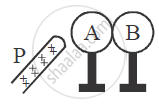
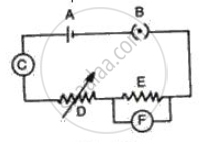
Fig. represents the circuit used for the verification of ohm's law. Label the different parts from A and F. State the function of each.
Rewrite the following statement by selecting the correct option.
The S.I. unit of resistance is __________.
State the relation correlating the electric current flowing in a conductor and the voltage applied across it. Also, draw a graph to show this relationship.
State the limitations of Ohm’s law.
Draw a neat diagram for the verification of Ohm’s law by voltmeter-ammeter method. By another diagram show the relation between p.d. and current.
A wire connected to a power supply of 230 V has power dissipation P1. Suppose the wire is cut into two equal pieces and connected parallel to the same power supply. In this case, power dissipation is P2. The ratio of `"P"_2/"P"_1` is
What is non ohmic device?
Obtain the macroscopic form of Ohm’s law from its microscopic form and discuss its limitation.
The variable resistance is called ____________.
Assertion: The statement of Ohm’s law is K = IR.
Reason: V = IR is the equation which defines resistance.
Ohm's law deals with the relationship between ______
Two cells of same emf E but internal resistance r1 and r2 are connected in series to an external resistor R (Figure). What should be the value of R so that the potential difference across the terminals of the first cell becomes zero.
Suppose there is a circuit consisting of only resistances and batteries and we have to double (or increase it to n-times) all voltages and all resistances. Show that currents are unaltered. Do this for circuit of Example 3.7 in the NCERT Text Book for Class XII.
The resistance of a resistor is reduced to half of its initial value. If other parameters of the electrical circuit remain unaltered, the amount of heat produced in the resistor will become ______.
How is electric current related to the potential difference across the terminals of a conductor?
Draw a labelled circuit diagram to verify this relationship.
Why should an ammeter have low resistance?
