Advertisements
Advertisements
प्रश्न
Define ampere and volt with respect to Ohm’s law.
Advertisements
उत्तर
Ampere: It is the S.I. unit of current. If a current flows in a conductor of resistance of 1Ω, when the potential difference across its ends is 1 volt, the current is said to be 1 ampere, i.e.,
1 ampere = 1 volt/1 ohm
Volt: It is the S. I. unit of potential difference. If a current of 1 ampere flows in a conductor of resistance 1 ohm, then potential difference across its ends is said to be 1 volt, i.e.,
1 volt = 1 ampere × 1 ohm.
संबंधित प्रश्न
Is Ohm’s law universally applicable for all conducting elements? If not, give examples of elements which do not obey Ohm’s law.
Name the unit of electrical resistance and give its symbol.
A resistance of 40 ohms and one of 60 ohms are arranged in series across 220 volt supply. Find the heat in joules produced by this combination of resistances in half a minute.
An electric bulb draws 1.2 A current at 6.0 V. Find the resistance of filament of bulb while glowing.
In the circuit shown in the figure, find the total resistance of the circuit and the current in the arm AD.
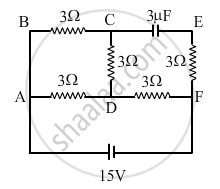
State macroscopic form of Ohm’s law.
What is ohmic device?
Obtain the macroscopic form of Ohm’s law from its microscopic form and discuss its limitation.
Which of the following I-V graph represents ohmic conductors?
Which of the following describes the V-I relation for an Ohmic conductor?
