Advertisements
Advertisements
Question
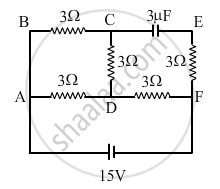
In the circuit shown in the figure, find the total resistance of the circuit and the current in the arm AD.
Advertisements
Solution
Since the capacitor will act as an open circuit here, the arm CE and EF will become ineffective. The circuit is now reduced to as below
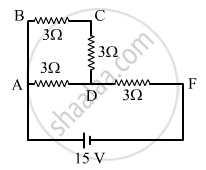
Effective resistance across AD = (BC + CD) ∥ AD
= \[\left( 3 + 3 \right) \lVert 3 = 2 \Omega\]
Total resistance of the circuit = AD + DF = 2 + 3 = 5 Ω
Total current in the circuit = \[\frac{15}{5} = 3 A\]
The current through AD and BCD will divide in the inverse ratio of the resistance.
∴ Current through AD = \[3 \times \frac{6}{\left( 6 + 3 \right)} = 3 \times \frac{6}{9} = 2 A\]
APPEARS IN
RELATED QUESTIONS
The relationship between the potential difference and the current in a conductor is stated in the form of a law.
- Name the law.
- What does the slope of V-I graph for a conductor represent?
- Name the material used for making the connecting wire.
When a 12 V battery is connected across an unknown resistor, there is a current of 2.5 mA in the circuit. Calculate the value of the resistance of the resistor.
The unit of electrical resistance is:
(a) ampere
(b) volt
(c) coulomb
(d) ohm
The filament of a bulb takes a current 100 mA when potential difference across it is 0.2 V. When the potential difference across it becomes 1.0 V, the current becomes 400 mA. Calculate the resistance of filament in each case and account for the difference.
Choose the correct alternative.
Which of the following is an ohmic conductor?
Which of the following I-V graph represents ohmic conductors?
The heat produced by a 100 w heater in 2 minute is equal to
Let the resistance of an electrical device remain constant, while the potential difference across its two ends decreases to one fourth of its initial value. What change will occur in the current through it? State the law which helps us in solving the above stated question.
A current of 3.2 mA flows through a conductor. If charge on an electron is −1.6 × 10⁻¹⁹ coulomb, find the number of electrons that will pass each second through the cross section of that conductor.
Ohm's Law states that for a metallic conductor, the current flowing through it is directly proportional to the potential difference across its ends, provided that:
