Advertisements
Advertisements
Question
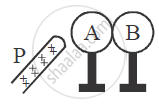
Two metallic spheres A and B kept on insulating stands are in contact with each other. A positively charged rod P is brought near the sphere A as shown in the figure. The two spheres are separated from each other, and the rod P is removed. What will be the nature of charges on spheres A and B?
Advertisements
Solution 1
On sphere A there will be negative charge & one sphere B there will be positive charge

Solution 2
When we bring a positively charged rod near the sphere A, The free electrons in the spheres are attracted to the rod. This leaves an excess of positive charge on the farther surface of sphere B. Now after separating the spheres and removing the rod, the charges on spheres rearrange themselves and get uniformly distributed over them, as shown in Figure given below.

RELATED QUESTIONS
Write the SI unit of resistivity
Ohm's law gives a relationship between:
(a) current and resistance
(b) resistance and potential difference
(c) potential difference and electric charge
(d) current and potential difference
The graph between V and I for a conductor is a straight line passing through the origin.
What should remain constant in a statement of this law?
What is meant by the drift speed of free electrons?
State and define Ohm’s law.
What is ohmic device?
Two cells each of 5V are connected in series across an 8Ω resistor and three parallel resistors of 4Ω, 6Ω, and 12Ω. Draw a circuit diagram for the above arrangement. Calculate
- the current drawn from the cell
- current through each resistor
The resistance of a resistor is reduced to half of its initial value. If other parameters of the electrical circuit remain unaltered, the amount of heat produced in the resistor will become ______.
Resistance (R) in a conductor is best described as:
Which formula is used with Ohm's Law to help determine power consumption in an electrical circuit?
