Advertisements
Advertisements
Question
Is Ohm’s law universally applicable for all conducting elements? If not, give examples of elements which do not obey Ohm’s law.
Advertisements
Solution
No, Ohm’s law is not universally applicable for all conducting elements. Vacuum diode semi-conductor is a non-ohmic conductor. Ohm’s law is not valid for it.
APPEARS IN
RELATED QUESTIONS
Find the resistance of a conductor if 0.24 A current is passing through it and a potential difference of 24 V is applied across it.
When a 12 V battery is connected across an unknown resistor, there is a current of 2.5 mA in the circuit. Find the value of the resistance of the resistor.
Write the SI unit of resistivity
The graph between V and I for a conductor is a straight line passing through the origin.
- Which law is illustrated by such a graph?
- What should remain constant in a statement of this law?
Fill in the following blank with suitable words:
Resistance is measured in .............. The resistance of a wire increases as the length ..............; as the temperature ..............; and as the cross-sectional area .............. .
How much energy is consumed when a current of 5 amperes flows through the filament (or element) of a heater having resistance of 100 ohms for two hours? Express it in joules.
What is the necessary condition for a conductor to obey Ohm’s law?
- Draw a V-I graph for a conductor obeying Ohm’s law.
- What does the slope of V–I graph for a conductor represent?
An electric bulb draws 1.2 A current at 6.0 V. Find the resistance of filament of bulb while glowing.
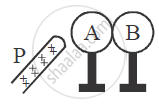
Two metallic spheres A and B kept on insulating stands are in contact with each other. A positively charged rod P is brought near the sphere A as shown in the figure. The two spheres are separated from each other, and the rod P is removed. What will be the nature of charges on spheres A and B?
Tick(✓) the correct choice in the following:
Ohm's law is applicable to
What is ohmic device?
Define temperature coefficient of resistance.
Two cells each of 5V are connected in series across an 8Ω resistor and three parallel resistors of 4Ω, 6Ω, and 12Ω. Draw a circuit diagram for the above arrangement. Calculate
- the current drawn from the cell
- current through each resistor
The slope of voltage (V) versus current (I) is called:

A student carries out an experiment and plots the V-I graph of three samples of nichrome wire with resistances R1, R2 and R3 respectively. Which of the following is hue?

A heater of 220 V heats a volume of water m 5 mint time. A heater of 110 V heat in ten second. The resistance of the conductor is
Suppose there is a circuit consisting of only resistances and batteries and we have to double (or increase it to n-times) all voltages and all resistances. Show that currents are unaltered. Do this for circuit of Example 3.7 in the NCERT Text Book for Class XII.
In which unit is the resistance of a conductor measured?
If the voltage across a conductor is increased while its temperature remains unchanged, what happens to the current flowing through it?
