Advertisements
Advertisements
Question
Fill in the following blank with suitable words:
Resistance is measured in .............. The resistance of a wire increases as the length ..............; as the temperature ..............; and as the cross-sectional area .............. .
Advertisements
Solution
Resistance is measured in ohm (Ω). The resistance of a wire increases as the length increases; as the temperature increases; and as the cross-sectional area decreases.
APPEARS IN
RELATED QUESTIONS
Let the resistance of an electrical component remains constant while the potential difference across the two ends of the component decreases to half of its former value. What change will occur in the current through it?
Why are coils of electric toasters and electric irons made of an alloy rather than a pure metal?
An electrical bulb is marked 200V, 100W. Calculate the electrical resistance of its filament. If five such
bulbs are connected in series to a 200V supply, how much current will flow through them?
State Ohm’s law and draw a neat labelled circuit diagram containing a battery, a key, a voltmeter, an ammeter, a rheostat and an unknown resistance to verify it.
In an experiment of verification of Ohm’s law following observations are obtained.
|
Potential difference V (in volt) |
0.5 | 1.0 | 1.5 | 2.0 | 2.5 |
| current I (in ampere) | 0.2 | 0.4 | 0.6 | 0.8 | 1.0 |
Draw a V-I graph and use this graph to find:
- the potential difference V when the current I is 0.5 A,
- the current I when the potential difference V is 0.75 V,
- the resistance in a circuit.
A wire of resistance 3 ohm and length 10 cm is stretched to length 30 cm. Assuming that it has a uniform cross section, what will be its new resistance?
Show by a diagram how two resistors R1 and R2 are joined in parallel. Obtain an expression for the total resistance of the combination.
How does an increase in the temperature affect the specific resistance of a semiconductor?
Tick(✓) the correct choice in the following:
Ohm's law is applicable to
Rewrite the following statement by selecting the correct option.
The S.I. unit of resistance is __________.
A wire connected to a power supply of 230 V has power dissipation P1. Suppose the wire is cut into two equal pieces and connected parallel to the same power supply. In this case, power dissipation is P2. The ratio of `"P"_2/"P"_1` is
The resistance of a nichrome wire at 0°C is 10Ω. If its temperature coefficient of resistivity of nichrome is 0.004/ °C, find its resistance of the wire at boiling point of water. Comment on the result.
Ohm's law deals with the relationship between ______
A metal rod of length 10 cm and a rectangular cross-section of 1 cm × `1/2` cm is connected to a battery across opposite faces. The resistance will be ______.
The circuit depicted in the figure is employed for studying Ohm’s Law. Instead of using a standard resistor, a student opts for a glass tube filled with mercury (tube 1), connected to the circuit through two electrodes, E1 and E2. He records the readings of the ammeter and voltmeter, thereby calculating the resistance. The student repeats the experiment by substituting tube 1 with tube 2, where the same amount of mercury fills tube 2.
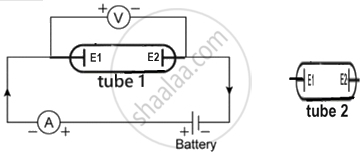
Neglecting internal resistance of the cell use (> or < or =) to compare:
- the resistance in both the cases.
- the voltmeter readings in both the cases.
- the specific resistance in both the cases.
A current of 3.2 mA flows through a conductor. If charge on an electron is −1.6 × 10⁻¹⁹ coulomb, find the number of electrons that will pass each second through the cross section of that conductor.
Ohm's Law states that for a metallic conductor, the current flowing through it is directly proportional to the potential difference across its ends, provided that:
For a continuous current flow through a conductor, what must be maintained across the ends of the conductor?
From Ohm's Law, since \[I \propto V\], the constant ratio \[\frac{V}{I}\] is defined as:
