Advertisements
Advertisements
Question
Suppose there is a circuit consisting of only resistances and batteries and we have to double (or increase it to n-times) all voltages and all resistances. Show that currents are unaltered. Do this for circuit of Example 3.7 in the NCERT Text Book for Class XII.
Advertisements
Solution
Let us first assume the equivalent internal resistance of the battery is Reff, the equivalent external resistance R and the equivalent voltage of the battery is Veff.
Now by applying Ohm's law,
Then current through R is given by `I = (V_"eff")/(R_"eff" + R)`
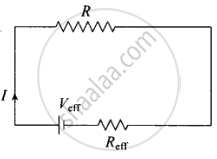
Now according to the question if all the resistances and the effective voltage are increased n-times, then we have
`V_("eff")^("new") = nV_("eff"), R_("eff")^("new") = nR_("eff")`
And Rnew = nR
Then, the new current is given by
`I^' = (nV_("eff"))/(nR_("eff") + nR) = (n(V_("eff")))/(n(R_("eff") + R)) = ((V_("eff")))/((R_("eff") + R)) = I`
The last result of two equations is same, so we can say that current remains the same.
APPEARS IN
RELATED QUESTIONS
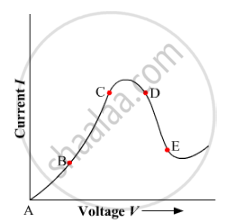
Graph showing the variation of current versus voltage for a material Ga As is shown in the figure. Identify the region of
(i) negative resistance
(ii) where Ohm's law is obeyed.
Write the formula of resistivity
Four resistances of 16 ohms each are connected in parallel. Four such combinations are connected in series. What is the total resistance?
In a conductor 6.25 × `10^16` electrons flow from its end A to B in 2 s. Find the current flowing through the conductor (e = 1.6 × `10^-19` C)
Calculate the current flowing through a wire of resistance 5 Ω connected to a battery of potential difference 3 V.
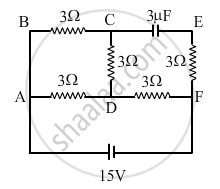
In the circuit shown in the figure, find the total resistance of the circuit and the current in the arm AD.
A wire has a length of 2.0 m and a resistance of 5.0 Ω. Find the electric field existing inside the wire if it carries a current of 10 A.
What is meant by the drift speed of free electrons?
State Ohm’s law.
Explain the equivalent resistance of a series resistor network.
The heat produced by a 100 w heater in 2 minute is equal to
Ohm's law deals with the relationship between ______
Ohm's Law states that for a metallic conductor, the current flowing through it is directly proportional to the potential difference across its ends, provided that:
In the context of Ohm's Law, Current (I) is defined as:
Resistance (R) in a conductor is best described as:
From Ohm's Law, since \[I \propto V\], the constant ratio \[\frac{V}{I}\] is defined as:
A resistor is connected in a circuit with a voltage of 12 V and a resistance of 24 Ω. What is the current flowing through the resistor?
