Advertisements
Advertisements
प्रश्न
What is ohmic device?
Advertisements
उत्तर
Materials for which the current against voltage graph is a straight line through the origin, are said to obey Ohm’s law and their behaviour is said to be ohmic.
APPEARS IN
संबंधित प्रश्न
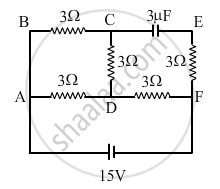
In the circuit shown in the figure, find the total resistance of the circuit and the current in the arm AD.
Draw a neat diagram for the verification of Ohm’s law by voltmeter-ammeter method. By another diagram show the relation between p.d. and current.
The ratio of the potential difference to the current is known as ________.
Explain the equivalent resistance of a parallel resistor network.
Which of the following is correct for V-I graph of a good conductor?
The unit of specific resistance is ____________.
State Ohm’s law? How can it be verified experimentally? Does it hold good under all conditions? Comment.
A metal rod of length 10 cm and a rectangular cross-section of 1 cm × `1/2` cm is connected to a battery across opposite faces. The resistance will be ______.
The circuit depicted in the figure is employed for studying Ohm’s Law. Instead of using a standard resistor, a student opts for a glass tube filled with mercury (tube 1), connected to the circuit through two electrodes, E1 and E2. He records the readings of the ammeter and voltmeter, thereby calculating the resistance. The student repeats the experiment by substituting tube 1 with tube 2, where the same amount of mercury fills tube 2.
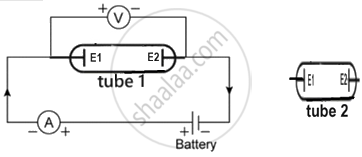
Neglecting internal resistance of the cell use (> or < or =) to compare:
- the resistance in both the cases.
- the voltmeter readings in both the cases.
- the specific resistance in both the cases.
A current of 3.2 mA flows through a conductor. If charge on an electron is −1.6 × 10⁻¹⁹ coulomb, find the number of electrons that will pass each second through the cross section of that conductor.
