Advertisements
Advertisements
प्रश्न
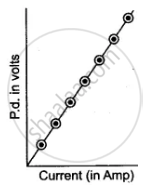
Draw a neat diagram for the verification of Ohm’s law by voltmeter-ammeter method. By another diagram show the relation between p.d. and current.
Advertisements
उत्तर

संबंधित प्रश्न
How should the two resistances of 2 ohms each be connected so as to produce an equivalent resistance of 1 ohm?
A resistance of 40 ohms and one of 60 ohms are arranged in series across 220 volt supply. Find the heat in joules produced by this combination of resistances in half a minute.
In the circuit shown below in Fig, calculate the value of x if the equivalent resistance between A and B is 4 Ω.

A metal sphere is kept on an insulting stands. A negatively charged rod is brought near it, then the sphere is earthed as shown. On removing the earthing, and taking the negatively charged rod away, what will be the nature of charge on the sphere? Give reason for your answer.

What is meant by the drift speed of free electrons?
Rewrite the following statement by selecting the correct option.
The S.I. unit of resistance is __________.
Define Current density.
An electronics hobbyist is building a radio which requires 150 Ω in her circuit, but she has only 220 Ω, 79 Ω, and 92 Ω resistors available. How can she connect the available resistors to get the desired value of resistance?
Two cells each of 5V are connected in series across an 8Ω resistor and three parallel resistors of 4Ω, 6Ω, and 12Ω. Draw a circuit diagram for the above arrangement. Calculate
- the current drawn from the cell
- current through each resistor
The unit of specific resistance is ____________.
